Produce QC Software Rollouts Succeed or Fail in the First 90 Days
- Quality Control App
The team is already stretched. The season does not pause for implementation, and nobody wants another software project that takes months before it produces anything useful.
A produce QC software rollout does not have to feel like this. After all, your are not rebuilding the operation from scratch. Instead, you are taking an inspection process the team already runs, standardizing it, and moving it onto a tool that makes the data easier to use.
The first 90 days are therefore all about progression: get one site live, surface the gaps in the existing process, stabilize the workflow, then expand it.
How long does a produce QC software implementation take?
For a single pilot site, a practical rollout can move from preparation to live inspections within the first few weeks, then use the rest of the first 90 days to stabilize the process and expand it. The exact timing depends on the number of sites, the number of specs, and how clearly the current QC process is already documented.
A realistic rollout often looks like this:
| Phase | Weeks | What happens | Output |
| Preparation | 1-2 | Gather current specs and defect lists, assign ownership, choose the pilot site and commodity | A written spec ready to configure and a named pilot team |
| Configuration | 2-3 | Set up specs, attributes, defect classes, sampling rules, and reporting structure | An inspection workflow ready to test |
| Inspector onboarding | 3-4 | Train pilot inspectors, run practice inspections, and calibrate on real lots | Inspectors comfortable with the workflow |
| Go-live and parallel run | 4-6 | Start live inspections while temporarily running the existing method alongside them | First real data and early discrepancies surfaced |
| Review and adjust | 6-8 | Refine spec wording, defect definitions, sampling rules, and report structure based on actual use | A stable configuration ready to scale |
| Expand | 8-12 | Roll the proven setup out to additional sites and inspectors | Multi-site data and the first useful supplier and trend views |
The important distinction is that “go-live” is not the end of implementation. It is the point where the real learning starts.
The first live inspections usually reveal where the existing process was already inconsistent: specs interpreted differently, overlapping defect definitions, or sampling methods that varied by site or shift. The goal of the remaining rollout is to resolve those differences before they are scaled.
Get the QC process clear before you configure the software
A question we have heard before: What should we prepare before the rollout starts?
The single biggest accelerator is having your quality spec and defect definitions in place before configuration.
If the team is still debating defect definitions or sampling rules, the software will simply expose those gaps during configuration.
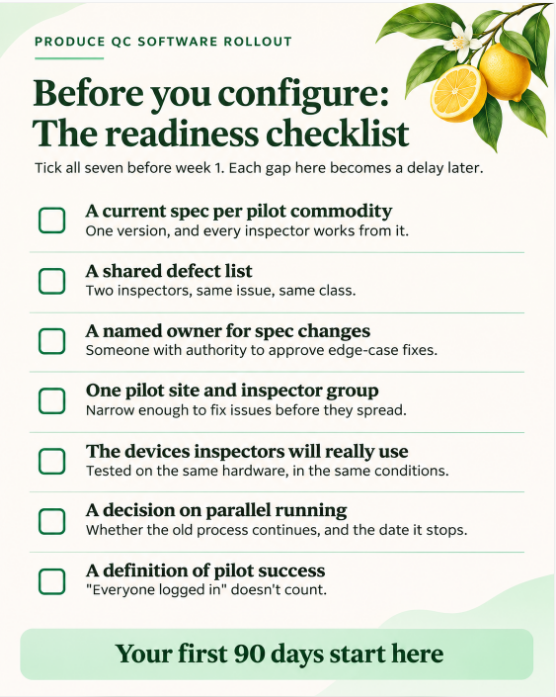
Before rollout starts, make sure you have:
- A current quality spec for each pilot commodity. If inspectors are working from different versions, standardize those first.
- A shared defect list. Defect classes should be clear enough that two inspectors will categorize the same issue the same way.
- A named owner for spec changes. Someone needs authority to approve changes once real inspections start exposing edge cases.
- A defined pilot site and inspector group. Start narrow enough that issues can be fixed before they spread.
- The devices inspectors will actually use. Test the workflow on the same hardware and in the same conditions as live inspections.
- A decision on parallel running. Agree in advance whether the old process will continue temporarily, and when it will stop.
- A clear definition of a successful pilot. “Everyone logged in” is not enough. Decide what needs to be working reliably before expansion begins.
Weeks 1-4: configure the workflow and get inspectors using it
Once you have chosen a QC platform, the first month is about getting one inspection workflow live quickly, then testing it with the people who will use it.
Start with the pilot commodity: configure the spec, attributes, defect classes, sampling rules, and basic reporting structure. Keep ownership close to the QC team so changes do not depend on a long vendor-led process.
Inspector onboarding should be practical too. Train on the device, run practice inspections on real lots, then compare results to calibrate how the team applies the spec.
Should you run the new QC software and the old inspection process side by side?
This is possible, but only for a short, defined period. It can allow the team to compare results, catch discrepancies, and adjust the new setup before fully switching over
Parallel running can help during the transition, but it needs an end date. Leave both systems in place too long and inspectors will keep falling back on the old process.
Weeks 4-8: go live and fix what the process reveals
The first live inspections expose inconsistencies that were already present in the QC process.
For many organizations, this is the first time those differences are visible enough to fix.
Typical corrections at this stage include:
- Clarifying a defect definition that inspectors are applying differently.
- Tightening a sampling rule that was being interpreted too loosely.
- Adding an internal quality measure, such as Brix, where appearance alone is not enough.
The parallel running we mentioned earlier actually has a place here. Comparing the new workflow against the old one for a period helps surface discrepancies before the switchover.
Weeks 8-12: expand the rollout and start using the data
Once the pilot site is stable, the program can roll out to additional sites, with new inspectors trained against the same specs, defect definitions, and sampling rules.
At this point, the data starts to become useful beyond the inspection itself. Teams can begin looking at:
- pass rate by supplier
- defect trends by commodity
- differences between sites or inspectors
Those turn the rollout from a digitization project into a management tool.
By the end of the first 90 days, you should have a stable, repeatable QC process that produces data teams can use for supplier, site, and quality decisions.
5 mistakes that turn a pilot into a project
Rollout friction comes from:
- Starting without a written spec. If the team is still debating tolerances and defect definitions during configuration, the rollout slows immediately.
- Launching too many sites at once. A pilot works because problems stay small enough to fix. Scale before the workflow is stable and you multiply the same issues.
- Running old and new processes in parallel indefinitely. Parallel running is useful for validation, but without an end date it becomes a permanent fallback.
- Leaving spec ownership unclear. Someone needs authority to approve changes when live inspections expose edge cases.
- Measuring success by adoption alone. Logins and inspection counts do matter, but the test is whether the new process improves consistency and changes decisions.
Strong rollouts narrow the scope early and expand only once the first workflow is stable.
Clarifresh scales this proven QC workflow for multi-site, high-volume fresh produce teams
Clarifresh follows the same rollout logic outlined above: start with a defined QC process, configure one pilot workflow, get inspectors using it, then expand once the setup is stable.
Quality teams can configure specs and inspection criteria directly in the platform, while remote training helps bring inspectors onto the same workflow without requiring every site to start from scratch.
Once the pilot is working, the same configuration can be extended to additional sites and teams. From there, live inspection data begins feeding the reporting layer, giving QC and procurement teams a clearer view of supplier, defect, and trend performance.
Computer vision can also support inspector calibration by helping apply defect criteria more consistently during inspections.
The practical advantage is speed to useful data: the rollout is designed to move from one working process to a repeatable multi-site model without turning implementation into a separate operational project.
A demo is the best way see what a Clarifresh pilot could look like in your QC operation.