What to Look for in a Produce QC Platform: A Buyer’s Evaluation Guide
- Quality Control App
A produce QC platform should be evaluated on how well it works in real inspection conditions, not on the length of its feature list. The most important criteria are specification flexibility, offline mobile use, grading consistency, reporting, integrations, adoption and multi-site scalability.
This guide explains what good looks like in each area, which questions to ask vendors and which warning signs often lead to poor adoption, rigid workflows or unreliable data.
Why the evaluation matters
The market for food and beverage quality management software was valued at $667.8 million in 2025 and is projected to grow at 11.7% annually through 2033. As more platforms compete for quality teams’ attention, buyers need a practical way to separate broad feature claims from capabilities that will hold up in real produce operations.
A produce QC platform only creates value when inspectors use it consistently and the resulting data can support real operational and commercial decisions.
That is why evaluation should go beyond feature lists. Buyers need to test how the platform performs across sites, buyer programmes, connectivity conditions and everyday inspection workflows.
What should you look for in a produce QC platform?
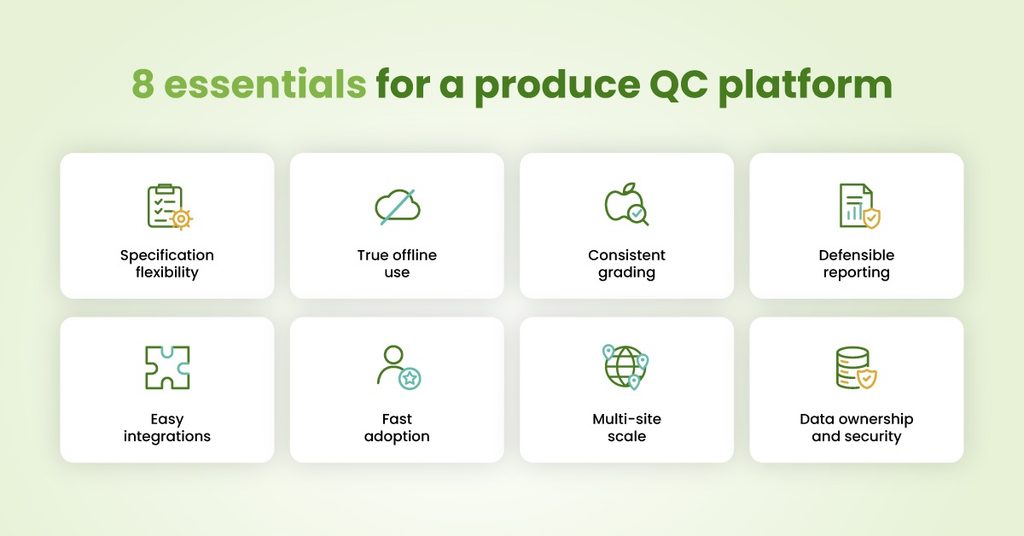
A strong platform should fit the way inspections actually happen, adapt as buyer requirements change and produce evidence that teams can trust. The criteria below provide a practical starting point for evaluation.
| Criterion | Why it matters | What it brings to your quality function |
| Specification flexibility and governance | Buyers, commodities and markets often apply different tolerances. Poorly controlled changes can create version confusion across teams. | One governed specification library with buyer-specific rules, approval controls, version history and clear ownership. |
| Offline and mobile use | Inspections often happen in fields, packhouses and receiving areas where connectivity is unreliable. | Core workflows run on standard phones or tablets without a connection, then sync reliably when access returns. |
| Grading consistency and measurement | Shared standards still need to be interpreted consistently across inspectors and sites. | Defined grading language, required capture steps, calibration support and automated measurement where the technology has been validated. |
| Reporting and evidence | Inspection results must support acceptance, routing, supplier conversations and commercial decisions. | Reports include lot details, specification version, measurements, photos, timestamps and a complete audit trail. |
| Integrations | QC data loses value when it remains isolated from operational systems and measurement devices. | Practical connections to ERP systems, APIs and relevant instruments, with clear ownership of setup and maintenance. |
| Adoption and implementation | A platform only creates value when inspectors can use it confidently in real operating conditions. | A defined rollout plan, manageable training requirements and representative workflows that users can complete without continual support. |
| Multi-site scalability | Growth increases the risk of local workarounds and inconsistent standards. | Central governance with local permissions, controlled specification releases and comparable reporting across sites and contract packers. |
| Data ownership and security | Inspection records may contain supplier, shipment and commercially sensitive information. | Clear ownership terms, role-based access, audit logs, backups and complete exports in usable formats. |
Questions to ask a vendor
Can one spec library handle different buyer and market tolerances?
Look for one controlled specification library that supports variations by buyer, commodity and market without creating duplicate templates.
Ask the vendor to show how specifications are approved, updated and traced back to individual inspections.
Does it work fully offline, and how does sync handle conflicts?
Inspectors should be able to access specifications, record measurements and capture photos without a connection.
Ask for a live airplane-mode test, followed by a sync demonstration showing how conflicts, images and timestamps are handled.
How is grading kept consistent across inspectors and sites?
Look for shared defect definitions, required capture steps and calibration workflows that reduce room for individual interpretation.
Ask the vendor to show how two inspectors would grade the same sample and how disagreements are reviewed.
Can reports be shared with buyers as defensible evidence?
Reports should include the lot, specification version, measurements, photos, timestamps and a clear audit trail.
Ask to see a real example and confirm whether buyers can open it without needing platform access.
What does it integrate with?
The platform should connect cleanly with the systems and devices already used by the operation, including ERP platforms and relevant measurement tools.
Ask which integrations are native, which require custom work and who maintains them after launch.
How long until a new inspector is productive?
A strong platform should be easy to learn without sacrificing control.
Ask for the expected onboarding time, then test it with a real inspector completing a representative workflow.
How does it scale across multiple sites and contract packers?
Look for central control over specifications, permissions and reporting, with enough flexibility for local teams to work effectively.
Ask the vendor to show how a new site is added, how updates are rolled out and how results are compared across locations.
Common mistakes when evaluating produce QC software
In our conversations with growers, packers, wholesalers and retailers, the same evaluation mistakes come up repeatedly. Buyers often focus on features before testing whether the platform works in real inspection conditions, across different sites, buyer programmes and levels of connectivity.
- Comparing feature lists instead of workflows: A long feature list says little about how the platform performs during a real inspection. Test representative workflows with the people who will use the system.
- Assuming connectivity will always be available: A platform that works well in a demo may struggle in fields, packhouses or loading areas. Verify the full offline workflow before purchase.
- Treating consistency as automatic: Digital forms do not guarantee consistent grading. Shared definitions, calibration and review processes still matter.
- Choosing flexibility without governance: A system should adapt to different buyers without creating uncontrolled copies, local workarounds or outdated specifications.
- Ignoring data access: Confirm that inspection records, photos and specifications can be exported in usable formats. Avoid discovering too late that critical data is difficult to retrieve.
The foundations of reliable produce QC
The strongest platforms combine specification flexibility, reliable offline use, consistent grading and clear reporting in one operational workflow. They should also fit existing systems, scale across sites and remain easy enough for inspectors to use every day.
How Clarifresh supports this approach
Clarifresh brings these capabilities together in a mobile-first, spec-driven platform built for fresh produce operations. Teams can manage buyer-specific specifications, complete inspections on standard devices and share structured quality evidence across sites.
The platform is designed to support consistent grading, offline field use, centralized reporting and integration with existing systems and measurement tools. That gives growers, packers, wholesalers and retailers one governed quality framework without forcing every site into the same rigid process.
Book a call to evaluate your produce QC requirements and see how Clarifresh fits your operation.
Frequently asked questions
What should I look for in a produce QC platform?
Prioritize spec flexibility across buyers and sites, genuine offline/mobile use, objective and consistent grading, shareable reporting, integration with your ERP and hardware, inspection speed, and ease of adoption. These predict whether a platform will actually be used and trusted.
Why do QC platforms fail after purchase?
Most fail on adoption and flexibility rather than features. If inspectors find it hard to use, if it assumes connectivity the field doesn’t have, or if it can’t flex to new buyer specs, it becomes shelfware regardless of its feature list.
What questions should I ask a QC software vendor?
Questions that you ask in due diligence should cover a wide range of platform capabilities:
– Whether one spec library handles different buyer tolerances
– Whether it works fully offline
– How grading stays consistent across sites
– Whether reports are buyer-shareable
– What it integrates with
– How quickly a new inspector becomes productive