How to Write a Fresh Produce Quality Specification (Step-by-Step Guide)
- Quality Control App

Every buyer defines “good” a little differently. One retailer may accept minor scarring. Another may reject the same lot. One inspector may grade firmness by feel. Another may look for a number. That gap is where quality disputes, downgrades, and wasted product begin.
What is a fresh produce quality specification?
A fresh produce quality specification is a written standard that defines what acceptable product looks like for a specific crop, buyer, grade, and use case. It turns quality expectations into measurable criteria: attributes, tolerances, grades, sampling rules, packaging requirements, and inspection methods.
A 2025 review of fruit and vegetable supply chains found median reported losses of 15% at both the on-farm postharvest handling stage and the market stage. Clear quality specs help teams identify those risks earlier, before quality issues become waste, claims, or avoidable downgrades.
This guide explains how to write a produce quality spec that inspectors can apply, suppliers can understand, and buyers can defend.
What should a produce quality spec include?
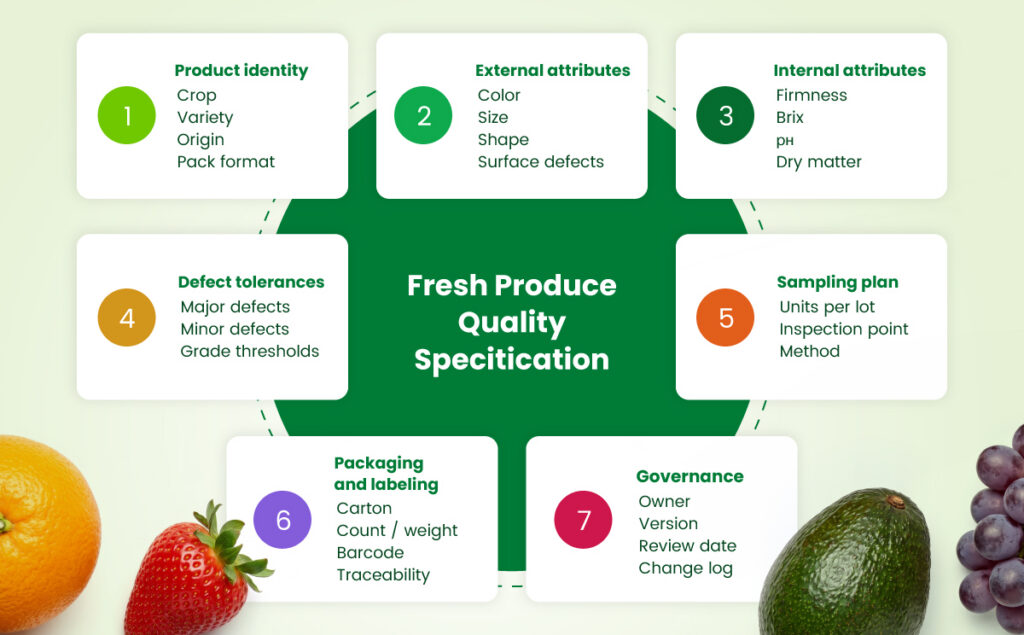
A produce quality spec should define the attributes that determine acceptance, downgrade, rejection, or redirection. At minimum, it should cover product quality, condition defects, packaging requirements, labeling rules, grade thresholds, defect tolerances, and the inspection method used to measure each attribute.
- External attributes: Visible characteristics such as color, size, shape, uniformity, scarring, bruising, and surface defects. Define the range, severity class, or threshold inspectors should use.
- Internal attributes: Measures that affect eating quality, maturity, shelf life, or buyer acceptance, such as firmness, Brix, pH, acidity, juice content, or dry matter. Use these only where they change the commercial decision.
- Quality vs. condition defects: Quality defects relate to appearance, form, grade, or specification fit. Condition defects relate to deterioration or handling, such as decay, mold, shriveling, softening, bruising, or breakdown. Condition defects usually carry higher rejection risk.
- Packaging and labeling parameters: Requirements for carton type, pack weight, count, PLU or barcode, country-of-origin labeling, brand marks, traceability information, pallet configuration, and temperature at dispatch or receiving.
| Attribute | Type | How it’s measured | Example tolerance |
| Color | External | Color chart, visual scale, or computer vision score | At least 90% of units within accepted color range |
| Size / caliber | External | Diameter, weight band, or count per carton | Defined size band per grade |
| Shape / uniformity | External | Visual assessment against category standard | Minor variation accepted; severe misshapen units limited by grade |
| Surface defects | External | Defect count and severity classification | Major defects ≤2%, minor defects ≤8% per sample |
| Bruising | Condition | Visual severity class and affected area | Severe bruising not accepted; minor bruising within tolerance |
| Decay / mold | Condition | Visual inspection by unit or sample | Zero tolerance or very low tolerance, depending on buyer agreement |
| Firmness | Internal | Penetrometer, durometer, or pressure test | Range defined by ripeness stage |
| Sugar content | Internal | Refractometer, measured in °Brix | Minimum Brix at receiving |
| Dry matter | Internal | Category-specific dry matter test | Minimum percentage by variety or maturity stage |
| Packaging / labeling | External / operational | Carton, label, barcode, pack weight, and pallet check | Must match buyer and regulatory requirements |
How do you write a quality spec in practice?
To write a fresh produce quality specification, start with the acceptance decisions your team already makes every day. Then turn those judgments into measurable attributes, tolerances, sampling rules, and ownership. A useful spec is a shared operating standard that inspectors, suppliers, and buyers can apply consistently.
1. Inventory the attributes that drive acceptance decisions for your category
Start by listing the attributes that actually determine whether a lot is accepted, downgraded, redirected, or rejected. These will vary by category.
- For grapes, berry firmness, shatter, color, decay, and stem condition may matter most.
- For citrus, size, external blemishes, juice content, color, and rind condition may be more important.
Separate commercial preferences from true quality risks. After all, the goal is not to measure everything, but to define the attributes that change the decision.
2. Define each attribute measurably
Every attribute in the quality specification should be tied to a scale, unit, or inspection method. “Good color” is not a spec. “At least 90% of units within the accepted color range” is closer. Size may be measured by diameter, count per carton, or weight band. Firmness may require a penetrometer or durometer. Sugar content may be measured in °Brix using a refractometer. Where visual judgment is unavoidable, use photo references and severity classes so inspectors are not relying on memory or opinion.
3. Set tolerances per grade
Once the attributes are defined, decide how much variation is acceptable by grade.
- A major defect is one that affects saleability, shelf life, food safety perception, or customer acceptance.
- On the other hand, a minor defect may affect appearance but still fall within the commercial tolerance for that buyer or market.
Set percentage thresholds for each grade. These thresholds should reflect both product biology and commercial expectations.
4. Define the sampling plan
A quality specification is only useful if it is clear how the inspection should be performed. Define how many units, cartons, pallets, or cases should be inspected per lot, and at which points in the supply chain. A receiving inspection may need different sampling rules than an in-field, packhouse, or pre-shipment inspection. The spec should also state whether samples are selected randomly, from specific pallet positions, or from high-risk areas. Without a sampling plan, two teams can inspect the same shipment and produce different results.
5. Reconcile against buyer specs and reference standards
Reference standards, including USDA grade standards where relevant, are a useful baseline for fresh produce grading, but they are not a complete buyer specification.
- Public standards help define common language around grades, defects, sizing, and condition.
- Buyer specs add the commercial layer: preferred appearance, ripeness stage, shelf-life expectation, packaging, private-label requirements, and market-specific tolerances.
Strong specs reconcile both. They avoid drifting below recognized standards, while still reflecting what the buyer has actually agreed to accept.
6. Pressure-test the spec with inspectors
Before a quality specification becomes operational, test whether different inspectors can apply it and reach the same result. Give two inspectors the same lot, the same spec, and the same sampling rules. If their scores differ materially, the problem may be the spec, not the inspectors. Look for vague defect definitions, unclear severity thresholds, missing photo references, or attributes that cannot be measured reliably in real inspection conditions. A spec that only works for the person who wrote it is not ready.
7. Version it and assign an owner
A quality spec should have a named owner, a version number, and a clear change history. Without this governance, teams end up inspecting against outdated PDFs, old email attachments, or buyer requirements that changed last season. Assign responsibility for approving updates, retiring stale specs, and communicating changes to QC, procurement, suppliers, and commercial teams. Every update should answer three questions: what changed, why it changed, and when the new version takes effect.
How do you set defect tolerances without making specs rigid?
Defect tolerances should be specific enough to create consistency, but flexible enough to reflect the natural variability of fresh produce.
Size, color, ripeness, firmness, sugar content, shape, and shelf life all shift by variety, season, origin, weather, handling, and time in transit. A strong quality specification recognizes that reality. It creates firm decision rules where consistency is possible, and controlled bands where variation is expected.
Start by separating critical defects from acceptable variation
Decay, mold, severe bruising, breakdown, contamination, or defects that affect food safety perception usually need strict thresholds. These are not preference issues. They affect saleability and in some cases compliance. For these defects, the spec should define a clear maximum tolerance and the action that follows when the threshold is exceeded.
Cosmetic and condition-based attributes often need more nuance.
- A small surface blemish may be acceptable for one buyer, grade, or market, but unacceptable for another.
- Color may need a range rather than a single target.
- Firmness may need to be evaluated against ripeness stage and intended shelf life.
- Size may need to align with carton count, retail format, or promotion requirements.
Beyond “pass” and “fail”
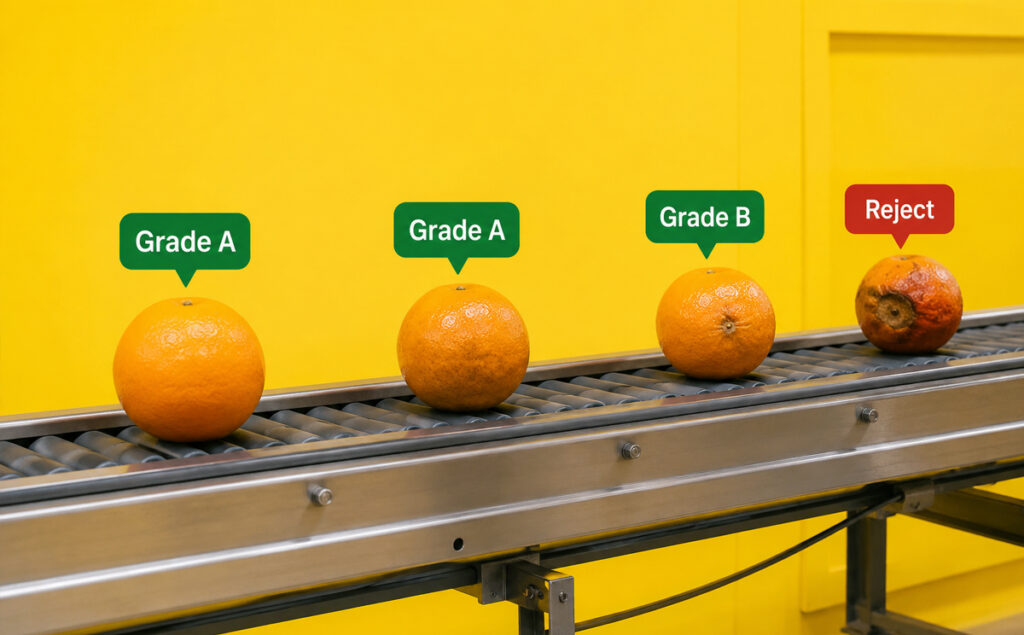
This is where grade bands become useful. Instead of writing one pass/fail standard, define what qualifies as premium, standard, processing, or rejected product. Each grade should have its own thresholds for major defects, minor defects, appearance, maturity, and packaging requirements. That allows teams to make better commercial decisions without treating every imperfection as a failure.
A practical tolerance structure might include:
- Zero-tolerance defects: contamination, active decay, or serious condition issues that create immediate rejection risk.
- Major defect thresholds: defects that materially affect saleability, shelf life, or customer acceptance.
- Minor defect thresholds: cosmetic or low-severity defects that are acceptable up to a defined percentage.
- Grade bands: different tolerance levels for premium, standard, value, or processing channels.
- Buyer-specific overrides: agreed differences for customers with stricter or more flexible requirements.
A good test is whether the spec can support both operational judgment and commercial clarity. If a lot is slightly below premium level but still acceptable for a different customer, the spec should make that visible. If a defect crosses the rejection threshold, the spec should remove ambiguity. The strongest quality specifications do not eliminate judgment. They structure it.
How do buyers and suppliers stay aligned on the same spec?
Buyers and suppliers stay aligned when the quality specification is shared, structured, current, and used as the basis for inspection on both sides. Misalignment usually starts when specs live in separate documents, tolerances are interpreted differently, or inspection results surface only after a shipment is already in dispute.
Start with a common quality language
A buyer may define “minor bruising” one way, while a supplier applies a different threshold. A category manager may update a ripeness requirement, but the change may not reach the packhouse team in time. An inspector may know the practical difference between acceptable and unacceptable scarring, but that knowledge may sit in their head rather than in the spec.
The result is a quality mismatch. The supplier believes the shipment meets the agreed spec. The buyer receives it and sees a different reality. By then, the conversation has shifted to claims.
Make every tolerance visible
A stronger approach gives both sides access to the same attributes, defect definitions, severity classes, grade thresholds, sampling rules, and photo references. This does not mean every buyer needs the same tolerance. It means every tolerance needs to be clear, documented, and applied consistently.
Use digital specs to reduce interpretation gaps
Digital specs move quality specifications out of static PDFs and into structured inspection criteria. Inspectors can score against the right attributes in the field, packhouse, warehouse, or receiving dock, while results are tied back to the spec version, sample, inspector, and evidence collected.
The test is simple: can both sides inspect the same lot, against the same spec, and understand why the result was accepted or rejected? If not, the problem may not be the product. It may be the specification system around it.
How often should quality specs be reviewed and updated?
Fresh produce quality specs should be reviewed at least seasonally, and sooner when buyer requirements, varieties, growing conditions, packaging formats, or rejection patterns change. A spec is only useful if it reflects the product being shipped, the buyer being served, and the inspection decisions teams are making now.
Assign one owner
A quality specification can involve QC, procurement, sales, category management, suppliers, and buyers. But the document itself still needs one named owner. That person is responsible for approving changes, maintaining the current version, retiring outdated specs, and making sure teams know which version applies.
Shared input is useful, but shared ownership is risky. When everyone can change a spec, no one is accountable for its accuracy.
Review specs by season, category, and buyer
Seasonal review is the minimum for most fresh produce categories. Some specs may need more frequent review during volatile periods, especially when weather, origin, variety, or maturity profiles shift. A grape spec at the start of the season may not be enough for late-season arrivals. A stone fruit spec may need different firmness expectations depending on ripeness stage and market destination.
Specs should also be reviewed when rejection data shows a pattern. If the same defect keeps causing claims, the issue may be product quality. It may also be that the tolerance is unclear, unrealistic, or interpreted differently by different teams.
Keep a change log and retire stale specs
Every update should be documented. The change log should show what changed, why it changed, who approved it, and when the new version took effect. This matters during disputes, onboarding, audits, and supplier reviews.
Without version control, teams may inspect against outdated PDFs, old email attachments, or buyer requirements that no longer apply.
| Governance area | Ungoverned specs | Governed spec library |
| Where specs live | PDFs, spreadsheets, emails, and local folders | Centralized library accessible to approved teams |
| Version control | Multiple versions circulate at once | One current version with archived history |
| Interpretation consistency | Inspectors rely on memory or local habits | Attributes, thresholds, and photo references are standardized |
| Onboarding new inspectors | Training depends on shadowing and tribal knowledge | New inspectors learn from the same structured criteria |
| Dispute resolution | Teams argue over which spec applied | Inspection results can be tied to the relevant spec version |
| Update speed | Changes move slowly through email threads | Updates can be approved, published, and communicated clearly |
Finally, a governed spec library should include sunset rules. If a buyer relationship ends, a packaging format changes, or a variety is no longer shipped, the related spec should be archived rather than left active. The aim is simple: inspectors should only see the specs they need to use.
Put the spec where the inspection happens
A quality spec only works if teams can apply it consistently. Clarifresh helps fresh produce teams turn static specs into structured digital criteria, so buyers, suppliers, and inspectors work from the same standard.
See how digital specs work in Clarifresh.
FAQs
What is the difference between a quality spec and a grade standard?
A grade standard is a public baseline for classifying produce by quality, size, defects, and condition. USDA grade standards, for example, help create a common language of quality.
A quality spec is the buyer- or company-specific layer on top. It defines what that business will accept for a specific crop, grade, market, and use case.Who should own the quality specification: QC or procurement?
Ownership should be shared, but not vague. QC should own measurability, inspection methods, defect definitions, and tolerances. Procurement or category management should own buyer alignment and commercial requirements. One named person should own the document itself, including version control, approvals, updates, and communication across teams.
Can one spec cover multiple buyers?
Yes, but it should not flatten every buyer into the same standard. A master spec with buyer-specific grade bands is usually stronger than separate one-off specs for every customer. It keeps the core quality language consistent while allowing tolerances, packaging rules, and acceptance thresholds to vary by buyer or market.
What makes a spec digital rather than a PDF?
A digital spec is not just a PDF stored online. It is a structured set of attributes, tolerances, sampling rules, and defect definitions that inspectors can score against during inspection. Results should sync in real time, link back to the spec version used, and create a usable quality record without re-typing data later.
How detailed should defect definitions be?
Defect definitions should be detailed enough that two trained inspectors can inspect the same lot and reach the same call. Avoid adjectives like “slight,” “serious,” or “acceptable” unless they are tied to severity classes, photo references, affected area, defect count, or percentage thresholds.