Produce Quality Is Finally Becoming Objective. That Changes Everything
- Quality Control App

For years, fresh produce quality has been managed with good intentions and imperfect tools. Standards existed, inspections happened. But rejections, claims, and waste continued to plague the supply chain.
Quality decisions were being made too late, interpreted too differently, and shared too narrowly to prevent downstream failures. That reality is now starting to change.
In our latest webinar with quality leaders, we discussed how that change is taking shape, and the work that still needs to be done.
Why Quality Still Breaks the Supply Chain
At its core, quality failure in fresh produce usually comes down to misalignment between buyers and sellers. Expectations diverge. Interpretations differ. Decisions are made based on partial information.
Clarifresh CEO Elad Mardix explained:
“Quality mismatch is a lose scenario where the seller does not get the price they wanted, and the buyer does not get the quality they expected.”
This mismatch is costly on both sides. Sellers face rejections and renegotiations. Buyers receive produce that doesn’t meet expectations. By the time the issue is visible, the produce is already in motion.
The underlying causes have remained remarkably consistent over the past decade. These weaknesses are one of the primary factors driving the estimated annual $88 billion in fresh produce waste.
The Structural Limits of Traditional Quality Control
Across regions and commodities, three systemic constraints have shaped how quality operates today.
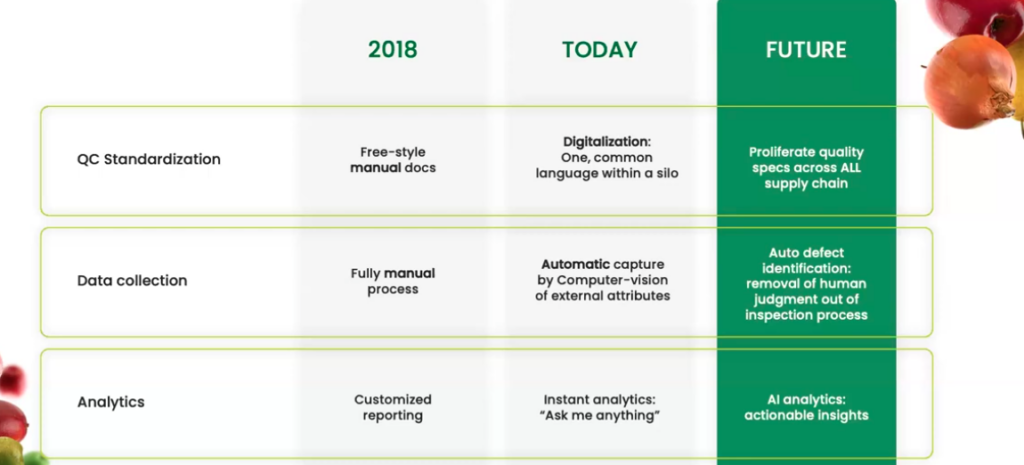
First, quality standards have lacked a truly shared language. Specifications are often detailed, but they live in static formats like PDFs, spreadsheets, or emails. Even when everyone agrees to follow the same spec, interpretation varies.
Second, inspections have depended heavily on human judgment. Experienced inspectors bring valuable expertise, but subjectivity introduces variation that is hard to scale across sites, teams, and seasons.
Third, quality data has historically arrived too late. Information is captured after inspections are complete, after shipments are planned, and sometimes after produce has already moved. In those conditions, quality becomes a reporting exercise rather than a decision-making tool.
Together, these constraints explain why quality issues persist even in highly professional operations.
Quality Standards Need to be Machine-Readable
One of the most important shifts discussed in the webinar was the move away from free-text quality specifications toward structured, digital standards.
Instead of long documents that describe quality in narrative form, quality criteria are now expressed as structured logic. The inspection process defines what data is collected. The standard defines how that data translates into a grade.
As it was described during the session:
“We broke very long documents into a very short mathematical sentence.”
This shift does not reduce the richness of quality standards. But it does remove ambiguity. By making quality rules explicit and machine-readable, grading becomes consistent regardless of who performs the inspection or where it takes place.
Once quality is expressed in this way, it becomes possible to automate parts of the process, analyze outcomes at scale, and build trust in the results.

Quality Visibility is Moving Earlier in the Process
Digitizing quality standards solves only part of the problem. The next step is extending visibility beyond a single organization.
Traditionally, quality information becomes available after goods arrive at their next destination. By then, decisions are limited. Rejections create friction. Waste becomes unavoidable.
The webinar outlined a different timing model:
“The buyer will be able to see the QC results while the merchandise is still within the seller’s facilities.”
When buyers have early visibility into quality outcomes, conversations shift from dispute resolution to proactive alignment. Shipments can be approved with confidence. Adjustments can happen before produce moves. Rejections become the exception rather than the norm.
At that point, quality stops being a checkpoint and starts becoming a coordination mechanism.
Automation Expands From Attributes to Defects
Automation in produce inspection has progressed in stages. Size and color attributes were the natural starting point. They are always present and relatively consistent to measure.
Defects present a more complex challenge. They are irregular, harder to detect reliably, and vary widely across commodities and growing conditions. This is why the webinar emphasized a hybrid approach rather than full automation overnight.
AI-assisted inspections allow systems to identify likely defects while keeping inspectors in the loop. Inspectors can validate or override results, improving trust and generating better data over time. This approach acknowledges current technical limits while still moving the industry forward.
Rather than replacing human judgment, automation is being used to focus it where it adds the most value.
Quality Data as Critical Decision Tool
Historically, quality data was fragmented throughout disconnected systems made up of paper records and spreadsheets. Answering even basic questions required manual effort and time.
The webinar highlighted a shift toward natural-language analytics and real-time insights. Instead of building reports after the fact, teams can now ask questions directly and receive answers immediately. Patterns, trends, and exceptions surface without weeks of analysis.
This evolution changes how quality teams operate. Instead of reacting to issues after they escalate, teams can intervene earlier. Alerts can be triggered when thresholds are crossed. Decisions can be guided by current conditions rather than historical averages.
Quality becomes part of daily operational control, not a retrospective exercise.
The Direction of Travel: Unification Replaces Fragmentation
The long-term vision articulated in the webinar extends beyond any single tool or workflow. It points toward an industry where quality is defined, evaluated, and communicated in the same way across the supply chain.
“The vision is to set one objective global standard for how everyone communicates and evaluates quality.”
Achieving that vision will take time, data, and collaboration. It will also require realistic expectations about what automation can and cannot do today. But the direction is clear.
As quality becomes more objective, more visible, and more predictive, the sources of friction that have long defined fresh produce trading begin to recede. Decisions move earlier, alignment improves, and waste has fewer opportunities to accumulate.
Book a Clarifresh demo to explore how shared quality visibility is shaping better decisions, before the first palette ships.