A Salmonella alert lands in your inbox on a Friday afternoon.
One of your products may be connected to a contamination event. The FDA wants traceability records. Retail customers want answers. Your operations team is scrambling to determine which shipments are affected.
At that moment, two very different scenarios can unfold.
Scenario 1: Unified quality control data contains the recall
In the first, your team can identify the exact supplier, lot, shipment dates, receiving records, and customer destinations within hours. You isolate four pallets, notify the right stakeholders, and contain the issue before it escalates.
Scenario 2: The recall unleashes chaos
In the second, the records are fragmented across spreadsheets, paper inspection forms, ERP entries, emails, and disconnected systems. Nobody can confidently determine which product is affected and which isn’t.
- Entire shipments are pulled as a precaution.
- Retailers remove product from shelves.
- Teams spend the weekend reconstructing records manually while revenue, trust, and operational continuity deteriorate by the hour.
The recall itself is the same, but the business impact is not.
That difference is why traceability is no longer just a compliance discussion in fresh produce. It has become a business continuity issue.
Fresh produce recalls are operationally complex, and worryingly frequent
Food recalls are not new. But the scale, visibility, and operational pressure surrounding them continue to intensify.
- According to Food Safety News and Sedgwick Brand Protection data, there were 415 FDA food recall events between January and September 2025, compared to 363 during the same period in 2024. The total volume of affected FDA-regulated food units surged by 75.8% from Q2 to Q3 2025.
- Produce also ranked as the second most recalled FDA food category by event count during Q3 2025.
- At the same time, public awareness around food recalls is growing rapidly. A GS1 US consumer survey found that 93% of Americans are concerned about how frequently food recalls occur.
At the same time, the bar has been raised
This does not necessarily mean the food supply is becoming less safe. Improved detection systems, stronger reporting requirements, and better testing procedures are all contributing to higher recall visibility. In many ways, the industry is becoming better at identifying and responding to risks.
But for growers, packers, wholesalers, and retailers, that improvement creates a new operational reality. When a recall happens, companies are expected to respond faster, with greater precision, and with complete traceability documentation already available.
The real risk isn’t the recall, but its blast radius
When people think about recalls, they often think in terms of food safety and compliance. Operationally, however, the biggest differentiator is usually containment.
Can you isolate exactly which products are affected, or do you have to assume everything is potentially compromised?
That distinction determines whether a recall becomes manageable or catastrophic.
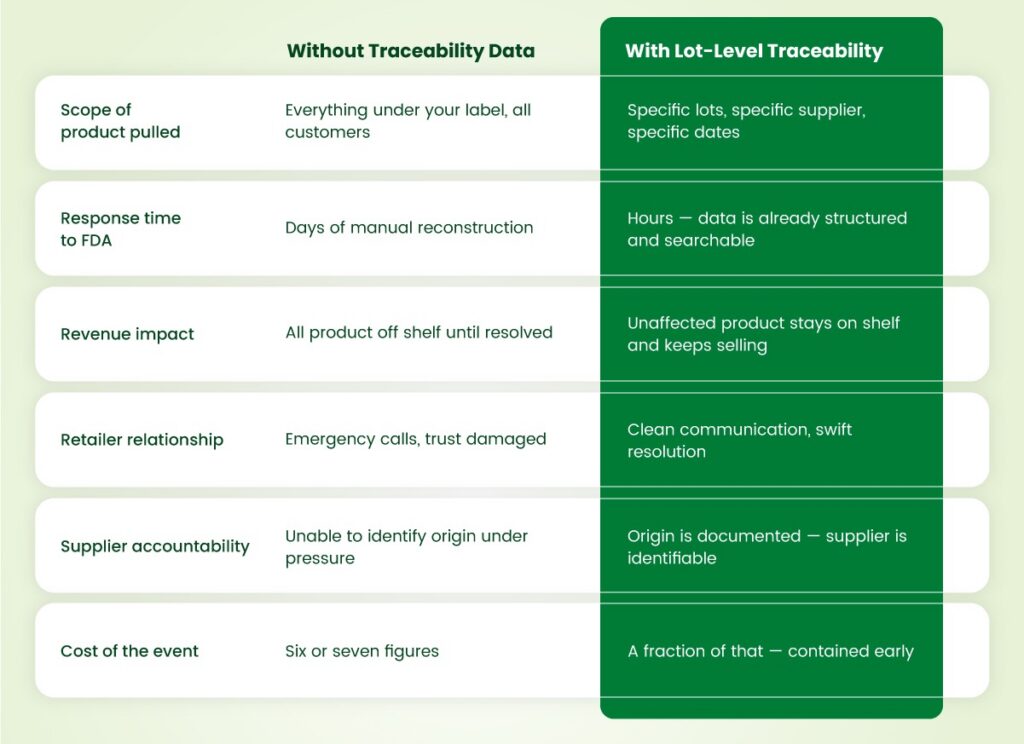
In many recall situations, the actual contaminated product represents only a fraction of the financial damage.
The larger costs often come from:
- Lost retail shelf space
- Emergency logistics and labor
- Product destruction
- Brand damage
- Delayed shipments
- Chargebacks and penalties
- Disrupted supplier relationships
- Revenue loss from unaffected product removed unnecessarily
This is especially true in fresh produce supply chains, where products move quickly across multiple suppliers, distribution centers, and retail destinations.
Without structured traceability data, companies are forced to widen the scope of recalls simply because they cannot confidently narrow it.
Fresh produce supply chains are especially vulnerable
Fresh produce creates unique traceability challenges compared to many other food categories.
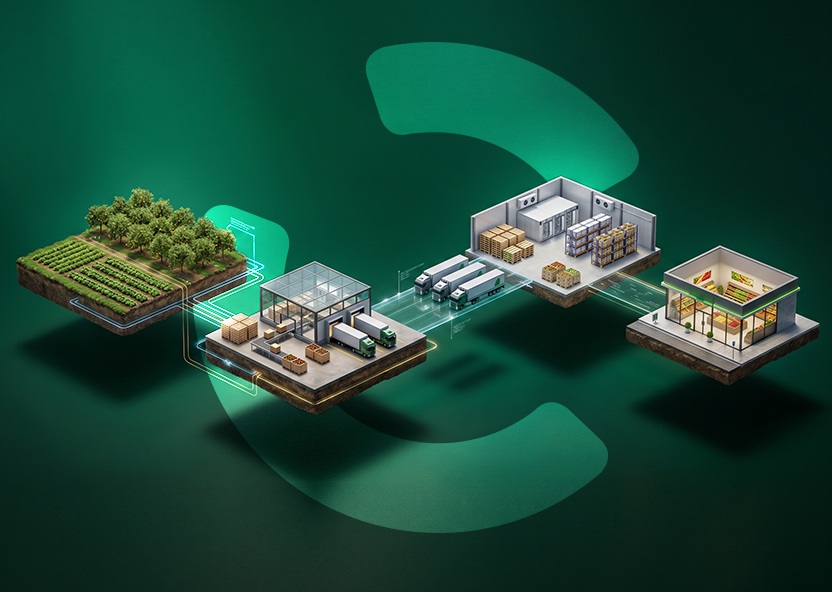
Products are highly perishable. Inventory turns rapidly. Supply chains are fragmented across growers, importers, distributors, packhouses, retailers, and third-party logistics providers.
And unlike packaged goods, fresh produce quality changes continuously. A shipment received on Monday may already present different quality conditions by Thursday. This creates pressure on quality control teams to move quickly while still documenting inspections thoroughly.
But many are still under-prepared
At the same time, many organizations still rely on partially manual processes like paper inspection forms that feed into spreadsheet-based records. Precisely because of this manual reliance, quality systems stay disconnected and can’t talk to each other. Inspections across facilities stay non-standard as a result, multiplying complexity and variability.
These workflows may appear manageable during normal operations. But during a recall investigation, they become major liabilities.
FSMA 204 was delayed, but the pressure isn’t going away
The FDA recently extended FSMA 204 enforcement timelines to July 2028. Some organizations interpreted this as a reason to delay traceability investments.
Operationally, however, the urgency has not changed. Major retailers are already imposing their own traceability and documentation expectations on suppliers.
Large grocery chains and retail buyers increasingly expect:
- Lot-level traceability
- Digital inspection records
- Supplier accountability documentation
- Faster recall response capabilities
- More consistent quality reporting
Because from a retailer’s perspective, the regulatory timeline is secondary to the operational risks they’re already facing day in, day out. Several of them are already enforcing their own (enhanced) traceability requirements, regardless of the FSMA deadline.
A contamination event affecting cucumbers, leafy greens, herbs, melons, or fresh-cut produce will not wait for the compliance calendar. So, while the FDA may have given the industry more time to implement systems, it can not give produce a longer shelf life.
Traceability Starts Earlier Than Most Companies Think
One of the biggest misconceptions around traceability is that it begins with ERP records. In reality, effective traceability starts at the quality control layer.
ERP systems may track where products moved, but inspection records establish critical operational context:
- What condition was the product in when it arrived?
- Which supplier sent it?
- Which lot was inspected?
- When was it received?
- Did it meet specification requirements?
- Were defects or concerns identified during intake?
Without that inspection-level visibility, traceability files become incomplete. This is why standardized, digital inspections are becoming foundational to modern fresh produce operations.
Every receiving inspection creates a timestamped operational record tied to:
- Lot code
- Supplier
- Shipment details
- Product condition
- Receiving date
- Quality outcomes
When these records are centralized and searchable, organizations can respond far more effectively during disruptions.
Instead of reconstructing information manually, teams can retrieve structured records immediately.
That speed matters a recall scenario, where every hour affects:
- Retail confidence
- Shelf continuity
- Operational costs
- Public communication
- Customer trust
Standardized inspection is your only lifeline during a recall
Having a clear operational picture of the supply chain is the best way to contain the impact of a recall event. That visibility comes from being consistent in the inspection process.
If inspection processes vary across facilities, inspectors, suppliers, or regions, the resulting data becomes unreliable under pressure.
But when inspection records follow consistent structures and criteria:
- Product histories become easier to trace
- Supplier accountability becomes clearer
- Quality patterns become easier to identify
- Teams can isolate affected inventory faster
- Documentation becomes exportable immediately
And importantly, unaffected inventory can remain in circulation, dramatically reducing losses. In many recall events, the most preventable financial losses come from removing safe produce because the organization lacks confidence in its traceability data.
The better the data structure, the smaller the operational blast radius.
Complete prevention isn’t realistic, but containment is
The fresh produce industry is entering a period where operational resilience matters as much as operational efficiency.
- Retailers want transparency, regulators want faster response times, and consumers expect accountability.
- And supply chains themselves are becoming more complex and more vulnerable to disruption.
In that environment, traceability is an operational safeguard. The businesses that invest in structured inspection data, standardized QC processes, and searchable traceability records are not simply preparing for compliance.
They are building the ability to:
- Reduce unnecessary product loss
- Protect retailer relationships
- Respond faster during crises
- Maintain continuity during disruptions
- Contain operational and financial fallout
Because ultimately, a recall is not just about whether contamination occurred. It is about whether your organization can prove what was affected, and just as importantly, what was not.
Conclusion
Many fresh produce organizations are still relying on fragmented inspection records and disconnected traceability processes. They will continue to find themselves expanding recall scopes simply because they lack operational certainty.
On the other hand, modernized organizations investing in standardized inspection data and lot-level visibility will have very different outcomes. Their investments position them to isolate issues faster, protect unaffected inventory, and preserve retailer trust under pressure.
On the surface, inspection data looks like a quality control tool. But in modern fresh produce operations, it’s more than that. It has become the operational evidence that determines whether a recall becomes a contained incident or a full-scale business disruption with cascading damage to reputation and relationships.
Frequently Asked Questions
We’ve never had a recall. Why should this matter to us?
Many major recall events involve suppliers with long histories of clean operations. By definition, they’re not fully foreseeable. Preparing for it in advance means your organization is ready to mitigate the damage if or when it happens.
FSMA 204 was delayed until 2028. Doesn’t that give us time?
For federal enforcement timelines, yes. But many large retail buyers are already requiring stronger traceability and documentation capabilities from suppliers today. Operational expectations are moving faster than regulatory deadlines.
We already track lot codes in our ERP. Isn’t that enough?
ERP systems help track product movement. Inspection records provide the operational context around supplier, condition, timing, quality status, and receiving outcomes. Effective traceability depends on both.
How quickly should traceability records be retrievable during a recall?
The FDA Food Traceability Rule requires certain records to be provided within 24 hours or within another agreed reasonable timeframe. Organizations relying on manual documentation often struggle to meet that expectation under pressure.
Can quality inspection systems detect Salmonella or Listeria directly?
No. Pathogens such as Salmonella and Listeria are not typically visually detectable during produce inspections. However, standardized digital inspection records improve traceability, documentation, accountability, and response speed during food safety investigations.