When Prices Spike, Someone Gets Squeezed on Quality. Make Sure It Isn’t You.
- Quality Control App

In a volatile produce market, the wholesaler’s position is structurally uncomfortable. You are absorbing risk from two directions simultaneously: growers and packers upstream who may be cutting corners under margin pressure, and retail buyers downstream who will hold you accountable for whatever lands on their shelves.
What happens in the middle, at your receiving dock, under time pressure, during a price spike: that is what determines which way that risk travels.
When prices are high and supply is tight, loads move fast and inspectors are stretched. Borderline produce gets waved through with a verbal call and no record. At the time, it feels like the only rational response to market conditions. Two weeks later, when a dispute arrives, both sides are working from memory of a shipment neither fully documented. That is where margin disappears. And the wholesaler, sitting in the middle, tends to absorb the loss.
The gap that costs wholesalers
There is a specific moment in every volatile market cycle where the real damage is done. That moment usually comes during the acceptance decision you make under pressure, without documentation, at the receiving dock.
Picture a high-volume morning at intake:
- An inspector is working through a heavy load, under time pressure.
- A borderline pallet arrives. The call is made verbally: it’s fine, put it through.
- No condition note. No grade record. No timestamp.
- Two weeks later, a dispute arrives. And both sides are working from memory of a shipment neither fully documented.
This is where margin disappears: in the structural exposure that sits at the centre of the wholesaler’s position. You don’t control how produce was grown, and you don’t control how it is displayed at retail. What you do control is what you accept, and what you can prove. In a volatile market, that control is the only leverage you have.
The inspection that matters most is the one most likely to be skipped
Fresh produce prices in 2026 are under sustained pressure. Tariff disruption, border delays, and supply volatility have created conditions where prices move fast and buyers take what they can get. The Yale Budget Lab has warned that fresh vegetables could increase by around 4.8% this year, with fresh fruit prices initially spiking by close to 7% before stabilizing. That’s before factoring in the secondary effects of delayed shipments and tightening supply windows.
Price spikes create a well-documented pattern of loosening quality tolerance across the supply chain. For wholesalers, the problem starts at the moment of acceptance.
This is precisely the environment where the temptation to wave borderline produce through is highest, and where the consequences of doing so are most severe.
- When supply tightens, product moves quickly, and speed does a lot of quality control work that the inspection process is not doing.
- When supply floods back and prices fall, the same product may sit for five or six days before it shifts.
- After day three, an “acceptable” receiving grade can slip significantly. And the single snapshot taken at intake no longer reflects what buyers or stores will receive.
The inspection cadence that works in a fast-moving market fails in a slow one. A static QC process has no mechanism for flagging that change. You find out when produce comes back.
Two operations, same market
The difference between documented and undocumented QC shows up most clearly in the middle of volatility. Consider two wholesalers receiving the same borderline shipment during a price spike.
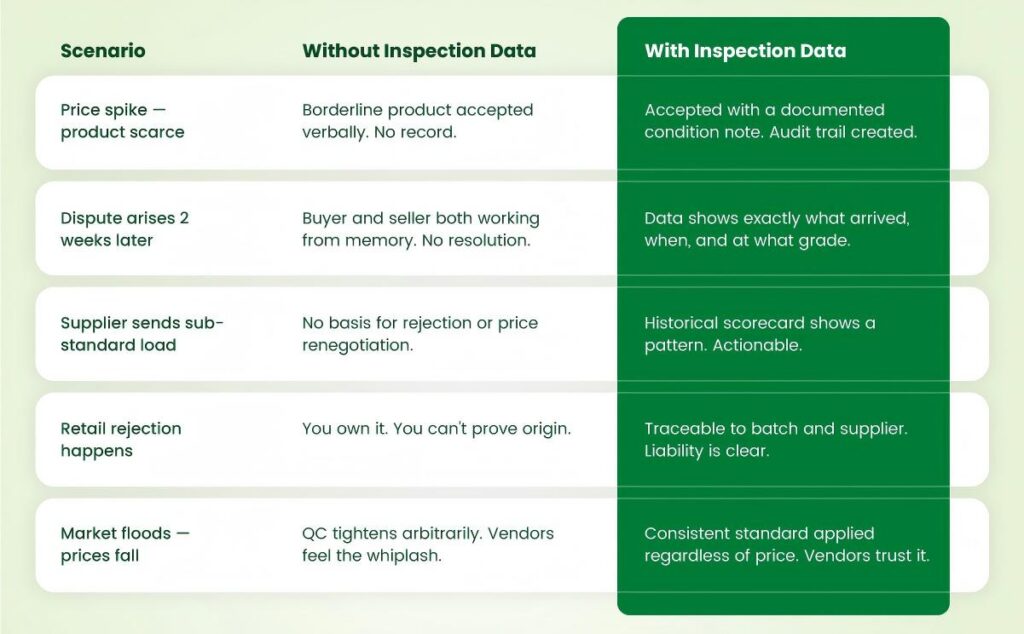
The first wholesaler accepts the borderline shipment verbally, under time pressure, without a condition record. When a dispute arises two weeks later, there is no paper trail. The conversation is about memory, rather than evidence, and the outcome typically favours whoever can apply more pressure.
The second accepts the same shipment — but with a documented condition note, a grade, and a timestamp. When the dispute comes, there is a record of exactly what arrived, when, and at what quality level. The liability is traceable. The conversation is short.
The same comparison holds for supplier accountability. Without consistent inspection data, there is no basis for rejecting a substandard load or renegotiating terms on a recurring problem. With a supplier scorecard built on documented intake inspections, there is evidence — and evidence supports a conversation that does not have to damage the relationship. Reliable suppliers should welcome that documentation. It protects them too.
The structural exposure of the wholesaler
It is worth naming the position clearly, not as a criticism but as a structural reality of where wholesalers sit in the supply chain:
- You don’t control how produce was grown (that is the grower and packer’s domain).
- You don’t control how it is displayed or stored once it leaves your facility (that is the retailer’s shelf).
- What you do control is what you accept, what you document, and what you can prove.
In a volatile market, data is the only leverage that travels with you through a dispute. The wholesaler who can produce inspection records for every lot received is the one who can win that dispute, push back on a supplier with evidence, and defend their position to a retail buyer without relying on a reconstruction of verbal agreements from six weeks prior.
Data discipline for fresh produce wholesalers
The goal of consistent QC data is not to reject more product. It is to know what you accepted and why, regardless of what the spot price is doing. In practice, that means four things:
- Standardised intake criteria that do not shift with market conditions. The spec sheet that applied in January applies in April, regardless of what tomatoes are selling for.
- Recorded acceptance and rejection decisions, each with condition notes, grade, and timestamp. A pattern across a supplier’s deliveries only becomes visible over time when you have the data to see it.
- Supplier scorecards that emerge from accumulated intake records. Who delivers consistently across a full season? Who cuts corners when margin pressure is high? That question has an answer when you have the data, and no answer when you don’t.
- A dispute-ready audit trail, so that when a retail buyer calls with a complaint, the conversation starts from evidence rather than competing memories.
Clarifresh’s intake inspection workflow is built around this discipline. The platform makes it possible to capture condition data at receiving, build supplier performance history over time, and surface the information that matters when a dispute arrives. Book a conversation to discuss how it applies to your operation.
The market will keep moving
Prices will spike again. Border situations will shift. Weather will disrupt supply. The question is not whether the market will create pressure — it is whether your QC process holds a consistent line regardless of what is happening to the spot price.
The wholesaler who builds that discipline during the volatile moment is the one whose vendor relationships, retail contracts, and margins are still intact when the market stabilises. The one who lets documentation slide under time pressure is the one absorbing the cost of decisions they cannot account for.
Frequently Asked Questions
Doesn’t tightening QC during a price spike mean I’ll run out of product?
Not if inspection is consistent and documented. The goal is to know what you accepted and why: a documented conditional acceptance is a very different thing from an undocumented verbal wave-through. You are not necessarily rejecting more; you are creating a record either way.
My vendors have been reliable for years. Do I still need to document everything?
Reliable vendors should welcome documentation. It protects them as much as it protects you. Quality disputes rarely arise from bad intent. They arise because both sides are working from different memories of the same shipment. Data resolves that without damaging the relationship.
How is this different from just enforcing the spec sheet harder?
Stricter enforcement in a volatile market creates vendor friction without solving the underlying problem. The issue is subjectivity and inconsistency: two inspectors applying the same spec can reach different conclusions on the same pallet. Standardised, recorded inspection removes the subjectivity and gives both parties something to refer back to.
What happens to supplier relationships if I start rejecting more?
Data-driven QC tends to strengthen supplier relationships over time. Suppliers understand the standard they are being held to, they can see their own performance trends, and disputes get resolved with evidence rather than accusations. That is a more sustainable dynamic than one where rejections feel arbitrary.