Cut costs or capture revenue? The real choice behind QC efficiency gains
- Quality Control App

Inspections take less time, and results become more consistent. Quality was a bottleneck, but now it’s manageable, even efficient.
At this point, leaders need to decide what to do with that extra capacity.
For many organizations, the answer is straightforward. They turn efficiency gains into cost savings, usually by reducing headcount or keeping it constant while increasing inspection volume. It’s a rational decision. But it frames efficiency as an endpoint.
In fresh produce, the greater opportunity lies in using that capacity to expand visibility, across a system where small quality issues compound quickly.
Key takeaways
- Modernizing QC creates capacity, not just efficiency
- Holding inspection activity constant reduces visibility as operations scale
- Expanding coverage enables earlier, more effective intervention
- Increased visibility reduces claims, waste, and inconsistency
- The largest gains come from preventing losses
The default response: efficiency as a cost lever
The appeal of cost reduction is easy to understand. When inspection becomes faster, labor becomes an obvious place to optimize. A smaller number of inspectors can maintain the same throughput. In some cases, the gains are dramatic, slashing inspection times by up to 60%. The financial impact shows up quickly, and leads to optimistic internal discussions.
This all appears clean and efficient. But beneath that surface, something more subtle begins to happen.
As the business grows, it adds more suppliers, more facilities, more shipments. The inspection footprint does not necessarily grow at the same pace. The same number of inspections is now spread across a larger and more complex operation.
What can happen in this situation is dilution, which may look very much like efficiency but isn’t:
- Visibility per shipment decreases
- Coverage becomes thinner
- More product moves through the system without being fully understood
Nothing has broken, but the quality control process functions with less control than before.
The alternative: expanding visibility across the process
There is another way to respond to efficiency gains. Instead of reducing inspection activity, some organizations use the additional capacity to extend it.
Introducing inspections at new points in the process
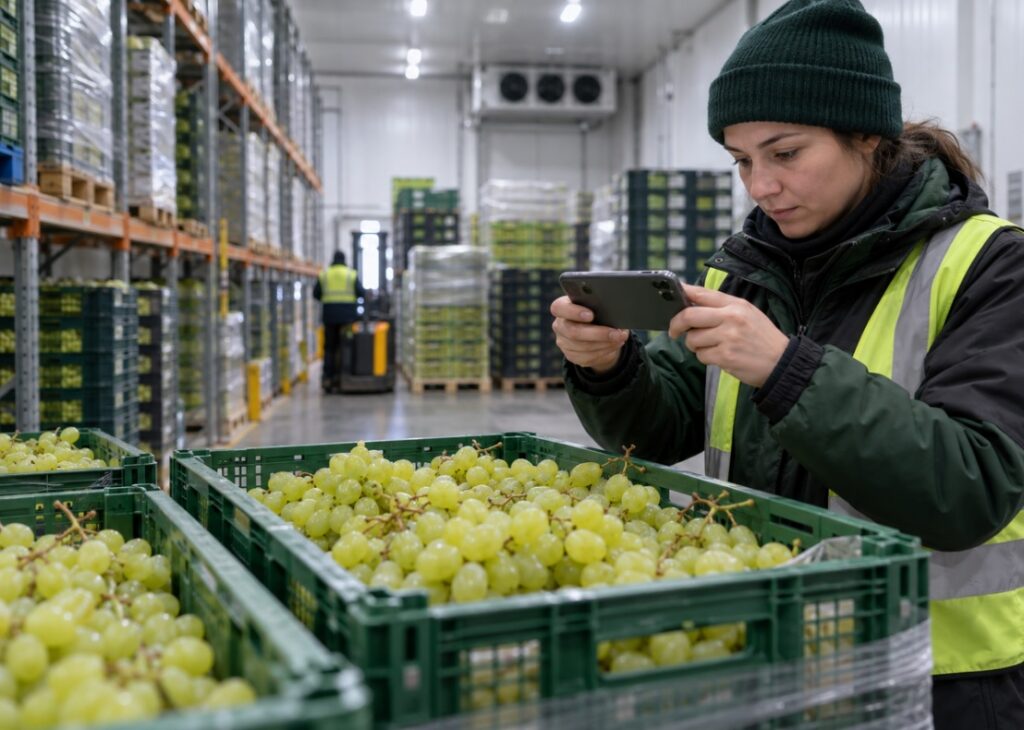
A packer that historically only inspected at intake could add an outbound inspection step before shipments leave the facility.
Fruit and vegetables that would have previously passed through based on initial grading is now reassessed against retailer-specific specs. This step catches maturity drift, softness, or inconsistencies that developed during packing and storage.
Increasing frequency where variability is highest
A distributor identifies that certain SKUs (high-turn items like berries or tomatoes) show the greatest variability in quality. Instead of sampling once per lot, they begin inspecting multiple pallets per shipment, or increasing inspection frequency during peak season.
Now, they have the ability to detect variability within the same load, rather than assuming uniform quality across it.
Expanding coverage across inbound, in-process, and outbound stages
A vertically integrated operation begins linking inspections across the full lifecycle of the product. They start checking quality on arrival from growers, monitoring condition during packing, and validating readiness before shipment.
Instead of relying on snapshots, the quality team gains a continuous view of how fresh produce evolves as it moves through the supply chain.
Structural changes with cumulative impact
These are structural changes that distribute inspection across more checkpoints, creating a different kind of system. In this system, teams find quality issues earlier, so they take important decisions with more context. And because the frequency of inspections is up, quality is being continually understood rather than assessed once.
Fresh produce is a category where time and variability are constant, so a shift in visibility can have a disproportionate impact.
What expanded inspection coverage actually enables
The benefits of this approach emerge through a series of small but compounding effects.
- Earlier detection of issues means that problems are addressed before they move downstream, where they are more expensive to resolve.
- Greater alignment between supplier and buyer reduces the likelihood of disputes, rejections, and claims, protecting both operations and relationships.
- More granular visibility into quality enables better sorting decisions. Produce can be directed toward the most appropriate market based on its actual condition, rather than a generalized assumption.
What changes is not just the speed of inspection, but the role it plays within the system. It becomes a source of control, rather than a checkpoint of verification.
The revenue impact of seeing more
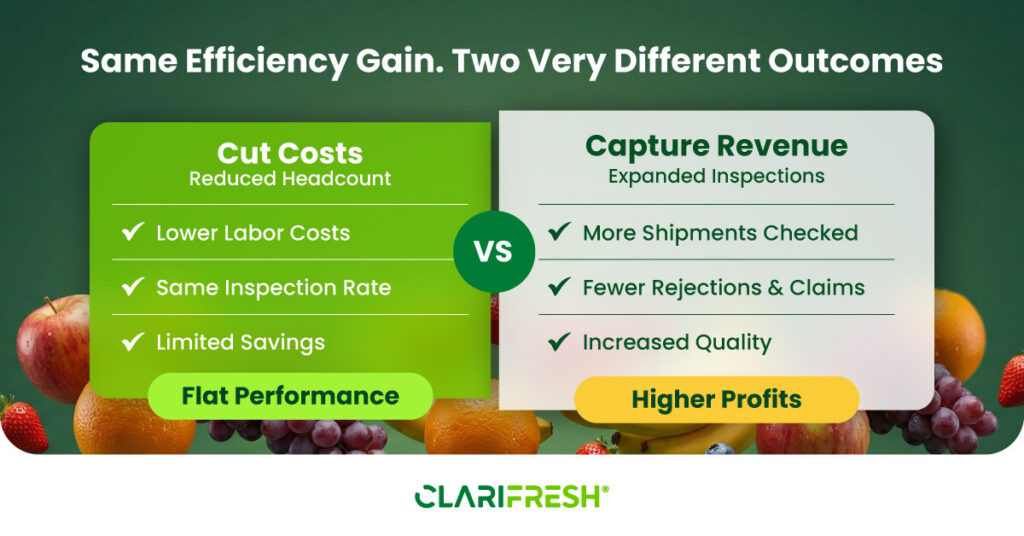
This is where the divergence between the two approaches becomes most apparent. Reducing headcount produces a predictable outcome in terms of lower labor costs and margins that improve in a linear, incremental way.
Expanding inspection coverage produces a different kind of return. By identifying issues earlier and more consistently, it reduces the likelihood of rejection, repacking, and downstream loss. Each avoided issue preserves value that would otherwise have been eroded across logistics, operations, and sales.
In this context, the impact is not additive. It is multiplicative.
Avoiding a single rejected shipment does more than eliminate a cost. It preserves the original sale, avoids the operational burden of recovery, and protects the relationship that underpins future business.
Across a large operation, these effects accumulate.
Revenue is not increased in a single transaction. It is protected, repeatedly, across thousands of decisions.
The invisible ROI of inspection coverage
The main challenge with this approach is that its value is not always immediately visible. In contrast to cost savings, which appear clearly in financial statements, the benefits of expanded visibility are more diffuse.
They show up as:
- Revenue that you would have lost, but don’t
- Waste that does not occur
- Claims that are never filed
- Shelf life that is preserved rather than shortened
These outcomes rarely draw attention to themselves because they are, by definition, the absence of problems. But over time, they represent a significant portion of operational performance.
For fresh produce, this decision is critical
The stakes of this choice are higher in fresh produce than in most other categories. The product is perishable, and quality changes continuously. Small deviations have outsized financial consequences.
A slight shift in ripeness can alter shelf life.
A minor inconsistency in grading can lead to rejection.
A delay of even a few days can move product from one market segment to another.
In this environment, visibility is a prerequisite for control. that control is what allows organizations to navigate variability without absorbing unnecessary loss.
If inspection coverage does not expand alongside volume, the system becomes increasingly opaque, as more decisions get made with less information. In this context, efficiency alone can create a false sense of improvement.
Reframing efficiency in quality control
It is common to think of efficiency as doing the same work with fewer resources. That’s fair, but in quality control specifically, it’s an incomplete definition. Efficiency in this context also includes the ability to extend capability without increasing cost.
So, when inspection becomes faster, the most important decision is how to use the additional capacity.
To ask:
- Where do we currently lack visibility?
- At what points in the process do issues emerge too late?
- What outcomes could be improved if we saw more, earlier?
Because in fresh produce, the difference between average performance and leading performance is actually defined by control. And control begins with visibility.
Clarifresh helps you decide where the efficiency goes
Most operations that modernize QC will describe the outcome the same way: they became more efficient. Some of them are right. They’re doing the same work faster, with fewer people. Their costs reflect this.
But some organizations have realized they can take these gains further. Rather than reducing the cost of inspection, they’ve used the same efficiency to increase what inspection actually delivers. And because fresh produce doesn’t pause while that distinction gets sorted out, the gap between what they control and what their competitors control widens every season.
Headcount reduction produces real savings, but they’re probably the smallest return available to you. The larger opportunity is still sitting in your operation: in the shipments you’re not fully seeing, the variability you’re not catching early enough, and the claims that are still finding their way to your customers.
Efficiency gave you capacity. Where you direct that capacity is the actual decision.
If you’re weighing what to do with your QC efficiency gains, talk to the Clarifresh team. We work with produce operations to identify where expanded visibility creates the most leverage.