The Grower-Packer Blame Game: What It’s Really Costing Your Packing Facility
- Quality Control App

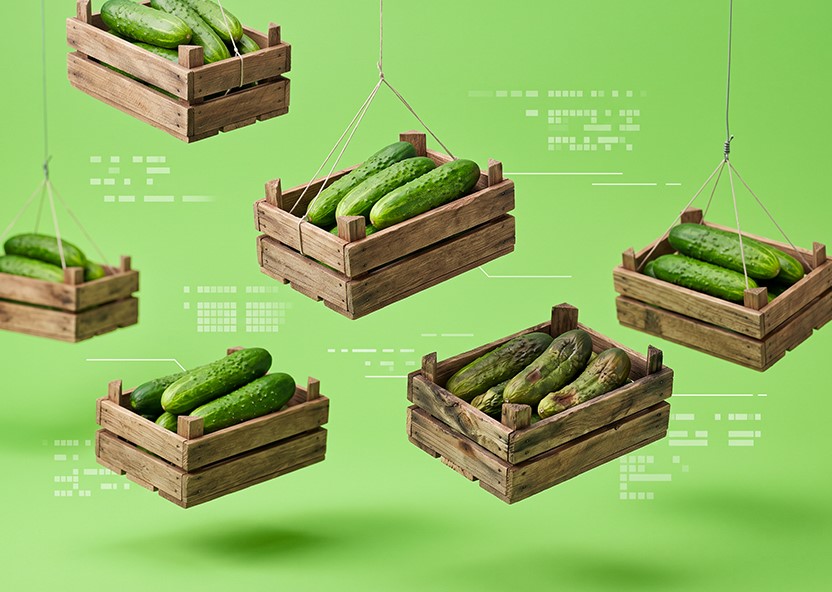
A bin of cucumbers arrives at your facility. Mixed sizes, off-spec produce packed alongside the good stuff. The line slowdown is the first sign, as workers start pulling produce that should never have made it this far. Grade two volume climbs.
This is not an unusual morning. For packing facilities buying from multiple growers, it is closer to a routine one. The grower-packer quality dispute is one of the most persistent friction points in fresh produce operations, and it rarely gets resolved because both sides are arguing from gut feel rather than data. In every grower-packer quality dispute, fresh produce becomes the evidence, and the cost sits with whoever handles it last.
Understanding where the costs accumulate, and what breaks the cycle, starts with understanding why the problem exists at all.
Over-picking is a constant pressure for growers
In the field, the incentive to pick everything can take hold. Leaving produce behind feels like leaving money behind, even when it’s undersize or visually off-spec. The assumption is that the packing facility will sort it out. If there’s no formal inspection at the grower’s end, there is no data to challenge that assumption.
This dynamic is reinforced by something that runs deeper than logistics. Growers are closer to their product than anyone else in the supply chain. They watch it develop through the season, they know their soil and their inputs. They carry that intimacy into their quality judgments. This is a genuine form of expertise. It is also, in one important respect, a limitation.
Quality thresholds in the field and quality thresholds at a retail DC are not the same standard. A grower assessing a bin of cucumbers is working from proximity and experience. A distribution centre receiving that same bin is working from retailer specs, shelf-life windows, and downstream rejection risk. Both assessments can be honest and still be measuring different things. Without inspection data from the grower’s end, that gap stays invisible until the product lands on a packing line.
In that case, packing facilities have to absorb the cost of decisions made upstream, because there’s no shared record to trace those costs back to their source.
The costs to the packing facility
Work slows down
Line slowdowns are the most immediate hit. When workers have to pull off-spec produce mid-process, throughput and pack-out efficiency fall. The more inconsistent the incoming product, the harder it is to maintain pace. The hours the facility loses add up across a season.
Quality slippage picks up
Grade-two volume increases. Below-grade produce is sellable, but at a fraction of the price of premium product. When growers send everything and let the facility sort it, a larger share of each bin ends up in the grade-two pile. That is packing yield loss that goes directly to the bottom line.
Produce goes to the wrong client
Premium packaging contamination risk is a subtler challenge. Under high-volume conditions, receiving inspections get rushed. Below-grade product slips through. It ends up in premium packaging destined for retail, and from there, it becomes a customer claim, a rejected load, or a shrink charge on the next invoice.
Repacking eats margins
Then there is the repack. When a load gets a rejection from a retailer or distributor, the costs cascade. The truck turns around and makes the return journey (which you pay for), before your team has to unload it (you pay for that, too).
Boxes, which can run a dollar each or more, get discarded for food safety reasons. Inner packaging follows. The product goes through the line again: new box, second truck, extra driver, more fuel. This is assuming the product survives a second run in usable condition. Meanwhile, the original buyer has already called your competitors to fill the order. Roughly eight times out of ten, that sale is gone.
Facilities do repacks because they are better than throwing produce away. But the economics are brutal. Reducing repack volume by even 10 to 25 percent is operationally significant.
Gut feel on both sides, costs on one
When a quality dispute arises between a grower and a packing facility, both sides are working from memory and estimates. The grower knows what the product looked like when it left the field. The packing facility knows what arrived on the dock. Without documented inspection data at both ends, there is no objective reference point.
Conversations become circular, because while the grower believes their quality is fine, the packing facility knows it is not. Neither side can prove their position, so the dispute either gets absorbed or creates ongoing friction.
This is a fresh produce quality dispute that plays out on gut feel rather than grower quality accountability data. It is also entirely preventable. The upstream accountability gap exists because there is no shared language between grower and packer. Inspection data creates that language.
Quality as opinion vs. data: Arguments end with the proof that inspection data provides
A receiving inspection at the packing facility creates an objective record of what arrived and in what condition. Over time, that record forms an objective basis for a grower scorecard that accurately grades each supplier.
Who picks to spec and who doesn’t: now you know
Facility managers can see, across a season, which growers consistently pick to spec and which do not. Size compliance, color stage, curvature tolerance, brix levels: each of these becomes a trackable data point rather than a point of dispute. Conversations that previously relied on gut feel now have a factual basis. Suppliers who fall short of standard get specific, documented feedback. Relationships that were previously adversarial have a mechanism for resolution.
The grower’s upside
This is also what growers themselves benefit from, even if the initial resistance is high. When inspection data flows back to the grower before product ships, they have the opportunity to catch their own problems rather than having them caught downstream. The cost of a field correction is a fraction of the cost of a rejected load.
It is a straightforward principle. When growers inspect before shipping and that data is visible to the packing facility, the blame game loses its foundation. Both sides are working from the same record.
Inspection records are supplier intelligence
This shared visibility is what platforms like ClariFresh make operationally practical. Digital QC records captured at the grower’s end and at receiving create a continuous, attribute-level view of supplier quality. Vendor scorecards emerge from the data rather than from memory. Supplier compliance conversations become factual rather than adversarial. And the packing facility gains the ability to route product intelligently, matching quality attributes to the right customer or channel before a rejection can happen.
For facilities looking to understand the difference between quality assurance and quality control as distinct functions in this process, ClariFresh’s guide on reducing fresh produce shrink covers the distinction in practical detail.
The grower-packer relationship does not have to be adversarial
Growers and packing facilities are not natural opponents. Ideally, they are partners whose business outcomes depend on each other. But the grower-packer relationship stays adversarial as long as quality is a matter of opinion, because opinion gives neither side anything to act on.
When both sides are working from shared inspection data, the dynamic shifts. Line slowdowns get traced to their source. Grade-two volume becomes a conversation rather than a cost to absorb. And growers who consistently hit spec get recognition for it. Cost sinks like repacks decrease because quality problems get caught earlier in the chain, where they cost less to fix.
If the grower-packer blame game is costing your facility, let’s talk about what changes when you remove the conditions that cause it.