Produce Quality Standards Drop When Prices Spike. Here’s How to Break the Cycle
- Quality Control App
Picture a DC receiving manager in early April. An 11-pound box of tomatoes is fetching $35 at wholesale. In a normal year, $10 is a reasonable average. At $35, nobody is asking hard questions. Produce is coming in fast, and buyers are grateful for whatever they can get. So the quality specs that looked important in January are quietly set aside. The fruit moves and the problem gets filed away for later.
Later, of course, is when it becomes expensive.
Produce quality control in a distribution center is supposed to be a consistent standard. In practice, it moves with the market.
When prices move, quality tolerance moves with them
There is a pattern that runs through fresh produce distribution that rarely gets discussed directly, even though most people in the industry have lived it. It goes like this:
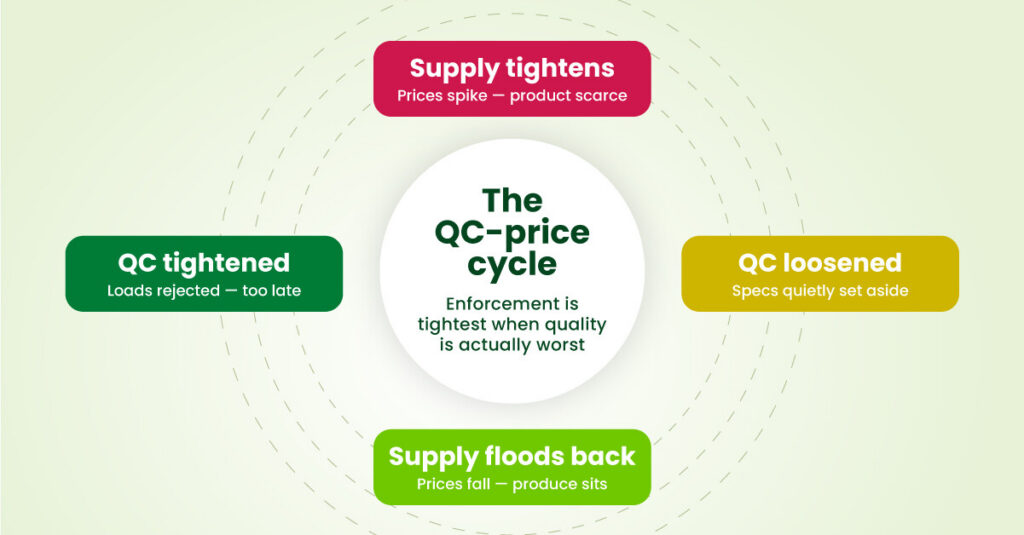
- In periods of supply tightening, prices go up and DCs accept produce they would normally reject.
- When supply floods back in and prices fall, DCs tighten specifications sharply. They start rejecting loads they approved without comment three months earlier.
The logic seems rational in the moment. When you have no choice, you take what you can get. But when you have options, you enforce standards. The dynamic is documented in USDA research on food loss drivers.
The problem is that this framework has the incentives exactly backwards.
The market sends the wrong signal at the worst time
High-supply, low-price markets (oversupply markets) are precisely the conditions where quality is hardest to maintain, for a couple of interlinking reasons:
- Produce sits longer, deteriorating all the while.
- Warehouse dwell time stretches from 24 hours to five or six days.
- Postharvest quality degradation accelerates.
- The loads being scrutinized and rejected are often worse than the loads that sailed through receiving during the price spike, because there’s less urgency driving them out the door.
This is the point where it’s so tempting to let things slide. Paradoxically, it’s also the point where enforcing quality standards is most important.
The warehouse time problem
In a high-price, low-supply market, produce barely stops moving: picking, packing and shipping can happen within 24 hours. Receiving inspection cadence matters, but the short handling window limits how much quality can degrade between grower and shelf. Speed is doing a lot of the quality control work that the inspection process is not.
When the market flips, that buffer disappears. Fresh produce can sit five to six days before it moves. After day three of sitting there, an “acceptable” quality rating can slip. So the single receiving inspection that worked when everything was turning in a day is no longer a reliable indicator of what buyers or stores will actually accept.
This is the gap that static QC processes cannot close. A receiving check is a snapshot. In a slow market, the story keeps changing after the picture is taken.
Static processes in a moving market
Most QC operations are built around a fixed inspection cadence. Inspectors perform the same check, regardless of what the market is doing. That design works when conditions are stable. But it fails when conditions shift quickly, which is closer to being the norm than the exception in fresh produce.
A pricing situation that is true today may look entirely different in two weeks. Operations that are not set up for continuous fresh produce quality data tracking have no early warning when that shift happens.
They find out when produce starts coming back, or when a buyer calls.
Vendor compliance and accountability suffer the same way
The other cost is vendor accountability. When quality data is inconsistent or market-reactive, it becomes nearly impossible to hold suppliers to a clear standard. If your tolerance for substandard product changes with the spot price, your vendor relationships will reflect that — and not in your favor.
Consistent data yields a new quality baseline
For quality data to be truly consistent, an organization must be able to track it across the cycle, not just at receiving, and not only when prices make enforcement feel comfortable.
Once you have that, you have reached a baseline that does not move with the market. You gain:
- The ability to identify which vendors perform reliably in high-supply conditions, when the temptation to cut corners is highest.
- Visibility into how product quality is changing while it sits, not just when it arrives.
- An early warning system that flags shifts in incoming quality before they become product shrink events or claim disputes.
The difference between static and continuous QC becomes most visible exactly when the market moves fastest.
The cycle will keep moving. Will you move with it?
Price volatility in fresh produce is not a problem that has a solution. At any point, weather can disrupt supply, and tariffs can reshape sourcing overnight. In this context, facing fewer disruptions is not a realistic aspiration. But fresh produce businesses can gain the tools to keep watching quality regardless of what the market is doing, and the data to act on what they see.
Book a demo to see how Clarifresh tracks produce quality at every point in the handling chain.