California’s early grape season: managing quality through the handover to imports
- Quality Control App

California’s table grape harvest is running ahead of its usual schedule. In at least one region, it began two to three weeks early, with harvesting expected to finish in mid-November. However, shipments can continue beyond the final picking date, supported by fruit held in cold storage. That makes the harvest calendar only part of the supply picture.
Retail produce buyers planning November orders and the transition to imports need to look at two factors:
- Available volumes: How much fruit suppliers can commit to upcoming orders.
- Current condition: How individual lots measure up against customer specifications.
A lot that meets specifications today still needs to be assessed against the time it will spend in transit and storage before reaching the retail shelf.
That is where the latest lot-level inspection becomes part of the sourcing decision. Reviewing current conditions against customer requirements and the planned time to sale gives procurement and QC teams a shared basis for deciding which fruit goes where. As buyers work through the remaining California supply and begin introducing imports, those assessments can help guide allocation decisions.
Plan the handover separately for green and red grapes
Green and red grapes have different outlooks for the remaining California season. In FreshPlaza’s October 22 report, Bari Produce’s Justin Bedwell expects green seedless supply to last until around Thanksgiving, roughly two weeks earlier than usual. Reds are expected to remain in good supply into early December.
These are a shipper’s expectations rather than fixed deadlines for the industry, but they underline why buyers should plan by variety and supplier.
For November orders, that means checking which commitments will be filled from ongoing harvests and which will draw on stored fruit. It also means reviewing the timing of incoming imports against those commitments, particularly where buyers may need to switch from California green grapes to imported supply sooner.
Match each lot to its intended selling window
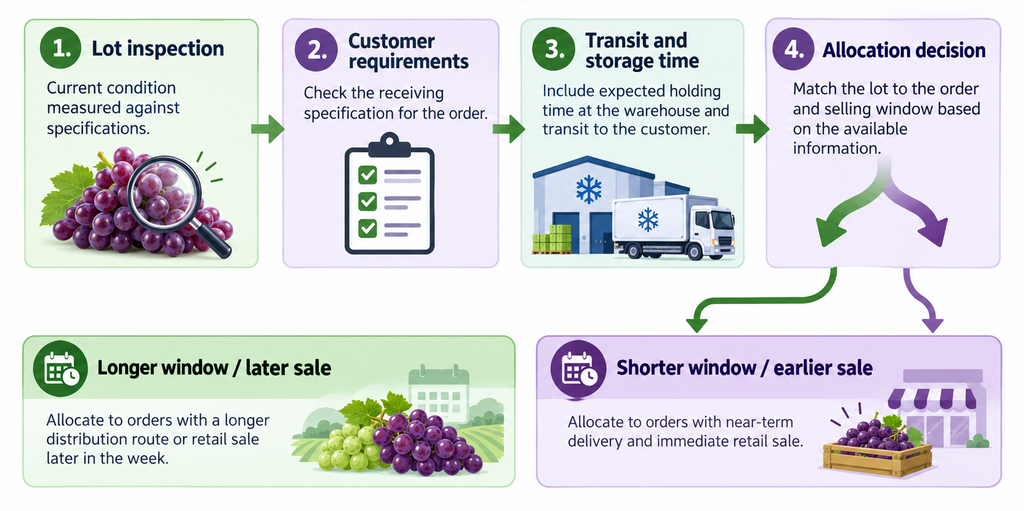
Before assigning grapes to an order, buyers need to review current condition against the customer’s requirements and the planned time to sale. That includes expected holding time at the receiving warehouse as well as transit.
A practical allocation example
Picture a distributor with two lots of the same variety. Both meet the relevant customer specifications at inspection. One order requires next-day delivery to a local retailer for immediate sale. The other involves a longer distribution route, with retail sale planned later in the week.
Before deciding which lot goes where, the team would review:
- Changes since receipt: Compare the latest findings with earlier inspections and flag any worsening defects for closer assessment, even where the lot remains within agreed limits.
- Available temperature history: Review recorded deviations or gaps in the handling record that could affect the decision.
- Requirements at destination: Check the receiving specification, expected selling window and any planned storage after arrival.
- The need for another inspection: Request an updated assessment where the existing record is no longer sufficient to support the delivery plan.
Where the evidence supports prioritizing one lot for earlier sale, it can be allocated accordingly, provided it still meets that customer’s requirements.
Shared definitions, buyer-specific tolerances
The important point is to avoid treating visual condition as a precise shelf-life calculation. Inspection findings should inform the decision alongside handling history, destination requirements and the time the fruit still needs to spend in the supply chain.
A consistent quality view as suppliers change
As buyers introduce imported grapes, they need to interpret new suppliers’ inspections alongside assessments of the California fruit still in stock. A common reporting framework makes that comparison more useful, while still allowing for the different specifications that apply to each variety and customer.
That kind of shared digital record is already being used in table grape operations. At RJN Cua Vineyards, inspectors moved from separate Word reports and iPad photos to completing reports and images together in the Clarifresh app. The company reported a 30% reduction in inspection time per review, with reports generated and shared in real time.
One inspection framework, shared across the handover
That consistency can extend across several parts of the QC process:
- Shared inspection criteria: Buyers can define and share the specifications they want suppliers and partners to work from.
- Documented inspection evidence: Digital QC reports can include findings and supporting photographs tied to the relevant inspection.
- Clear inspection timing: Inspection dates and times give teams context on how current an assessment is when reviewing fruit for an upcoming order.
- A common record for different teams: Procurement, QC and operations can refer to the same inspection evidence when discussing allocation or release decisions.
For a retailer, the practical application may be a discussion between procurement and distribution-center teams about whether the assessed condition supports planned store deliveries. For a distributor, it may be a review of which lots suit different customer orders.
In both cases, the inspection record gives teams a shared starting point. If a delivery schedule changes or fruit remains in storage longer than expected, QC can revisit that evidence and decide whether another inspection is needed before the lot moves.
Use quality data to manage the transition
California’s earlier grape season makes the next few weeks a planning exercise as much as a sourcing one. Buyers need to know what volume is available, but they also need a current view of the condition of the fruit behind those numbers.
As California supply winds down and imports take a larger share of the program, consistent lot-level inspections can help procurement, QC and operations teams make better allocation decisions and respond when timelines change.
The key is to keep quality information current, comparable and connected to the order it is meant to support.
Book a demo to see how Clarifresh helps fresh produce teams keep quality data consistent and actionable across changing suppliers and seasonal transitions.