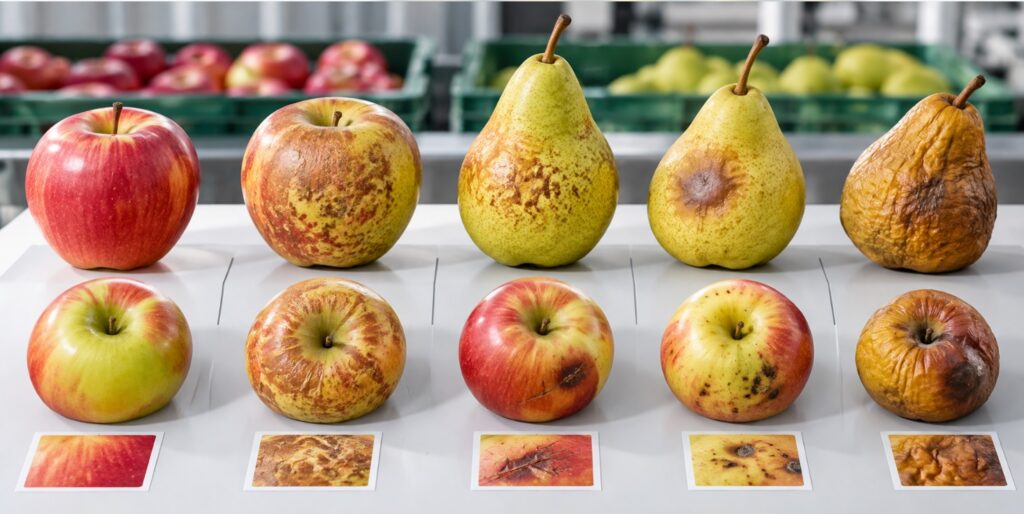
In the fresh produce business, margins are thin, competition is fierce, and every delay or rejection chips away at profitability. Wholesalers that squeeze in a special way, because of their tough position right between grower expectations and retailer demands.
For many wholesalers, quality control (QC) is a constant source of frustration. It’s labor-intensive. It’s expensive. And it’s prone to bottlenecks. But without it, customer trust evaporates.
With the right tech, though, QC doesn’t have to be a cost sink. It can actually become a strategic investment yielding a 7X return on investment (ROI) every year. In this article, we investigate the figures and demonstrate the unique value for fresh produce wholesalers.
What Quality Control Looks Like for Wholesalers
The reality on the ground is that most wholesalers don’t have the infrastructure of a grower or a retailer. Around 75% rely on shortcuts, eyeballing surface fruit, pulling a few pallets from the top layer, and calling it an inspection. Reports, when they exist, are often incomplete and inconsistent. That leaves wholesalers exposed: blind spots drive up shrink, and missing documentation weakens their position in disputes.
The minority 25% (those with structured QC programs) are further along. They generate reports, track consistency, and think about supplier performance over time. But even these wholesalers struggle to scale without ballooning labor costs.
The Impossibly High Price of Scaling Status Quo QC
Running a traditional QC program means scaling costs directly with labor. It’s virtually impossible to escape the bind: if you increase shipments, you need more inspectors. Shipping more produce bumps up revenue, but payroll goes up at the same time and eats away those gains.
Let’s consider a typical quality control setup:
- 6 inspectors
- $20/hour
- 1,000 inspections per month
That translates to about $20,000/month in QC payroll, nearly a quarter of a million dollars annually.
And that’s just the obvious cost. To arrive at the true cost of QC, we need to factor in rejection losses, shipment delays, and the administrative burden of paper or spreadsheet-based workflows.
Think of it this way: if one rejected shipment costs $15,000 in lost revenue and transport, and if even two pallets are rejected each month due to inconsistent inspection results, that’s another $360,000 in annual losses stacked on top of payroll. Traditional QC is expensive. But even worse: it’s risky.
Running the ROI Math
Now let’s look at what happens when you improve efficiency.
With QC automation and digitization, inspections can run at 2X speed, cutting costs in half without sacrificing accuracy. Using the same example:
- Current approach: $20,000/month
- With 2X faster inspections: $10,000/month
- Annual SaaS cost for 6 inspectors: $17,316
That’s hundreds of thousands saved annually. Another way to frame it: each 100 inspections costs around $1,000 with manual methods. With automation, it’s closer to $500. Multiply that across thousands of inspections, and the difference is transformative.
And unlike manual QC, this model actually scales efficiently. Instead of costs rising linearly with every additional inspector, wholesalers can absorb growth without proportionally increasing payroll.
Proof From the Field: Coccinelle’s Efficiency Gains
Wholesalers like Coccinelle are leading the way in modern QC, and reaping the benefits of AI-powered inspections. They replaced paper-based QC processes with intelligent automation that eliminated the need to identify, interpret and record defects manually. They’ve effectively freed their inspectors from hours of grind work, and protected their supply chain from the error rate that inevitably impacts manual operations, even with the most qualified inspectors.
Their quality teams now record results directly on mobile devices, standardizing data capture and eliminating redundant paperwork.
The results were almost immediate:
- 50–60% reduction in inspection times
- Faster, more accurate reporting
- Freed-up resources for higher-value tasks
- Greater confidence in consistency across inspectors
For wholesalers, faster QC means shipments leave sooner, with fewer disputes and rejections down the line. Customer relationships strengthen, because your brand becomes a byword for reliability.
What About Operational Gains?
The ROI isn’t only about labor costs. Smarter QC programs deliver value across the supply chain:
Faster shipments
Shorter inspection times mean trucks move faster, getting fresher produce to retailers and reducing shrinkage in transit. A day saved in QC can mean two extra days of shelf life at the store.
Fewer rejections
Consistency reduces costly disputes and returns. Retailers who receive uniform quality are less likely to renegotiate prices or reject pallets.
Lower training burden
Standardized digital processes make it easier to onboard new inspectors. In seasonal or high-turnover environments, this can save weeks of lost productivity each year.
Better data, better decisions
Real-time dashboards and reports replace spreadsheets, enabling proactive adjustments. For example, if early signs of bruising appear in a batch, the system can trigger an immediate diversion to processing instead of risking a costly rejection at retail.
Audit readiness
With complete, digital records, preparing for compliance checks or retailer audits becomes faster and less disruptive.
These improvements compound over time. For wholesalers who live in the constant pressure of thin margins, that is a welcome relief. But more than that, it quickly becomes a powerful competitive advantage. .
Rethinking QC as an Investment
For years, wholesalers have thought of QC as a necessary overhead, something to minimize, but never eliminate. That mindset is changing.
Instead of fixating on a monthly software fee, the real question is: What are we already spending on QC today, and how much could we save?
A modest SaaS subscription, equivalent to what many wholesalers spend on a single rejected shipment, can unlock six-figure annual savings. And beyond the numbers, it delivers something even more valuable: trust from your partners, confidence in your operations, and the ability to grow without being shackled by outdated processes.
What Could a 7X ROI Look Like for You?
QC doesn’t just protect margins. It can actually expand them. When inspections run faster, more consistently, and with better data, wholesalers move from firefighting to strategic advantage.
The proof is already in the field: wholesalers are saving time, cutting costs, and improving outcomes with AI-powered QC.
Let’s run the numbers together and see how much you could save, both upfront and down the line.