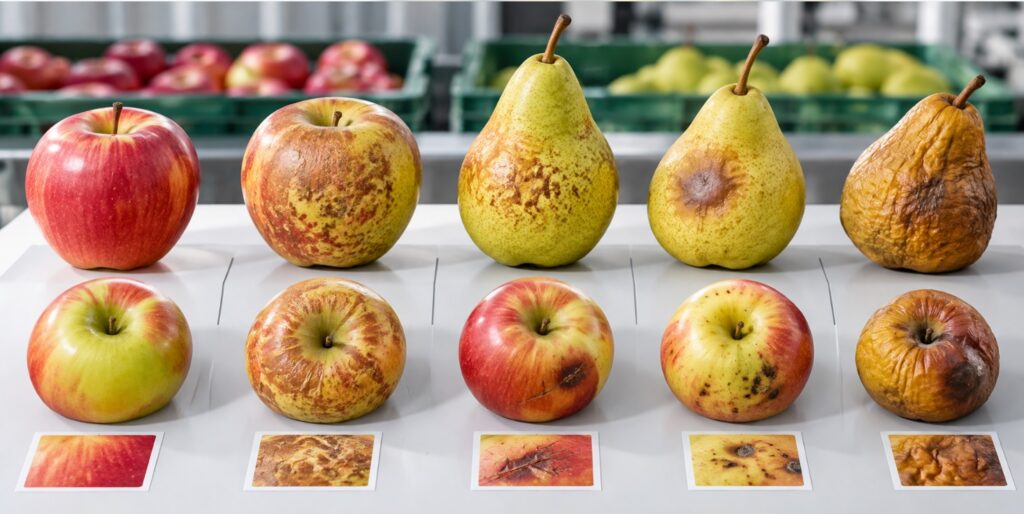
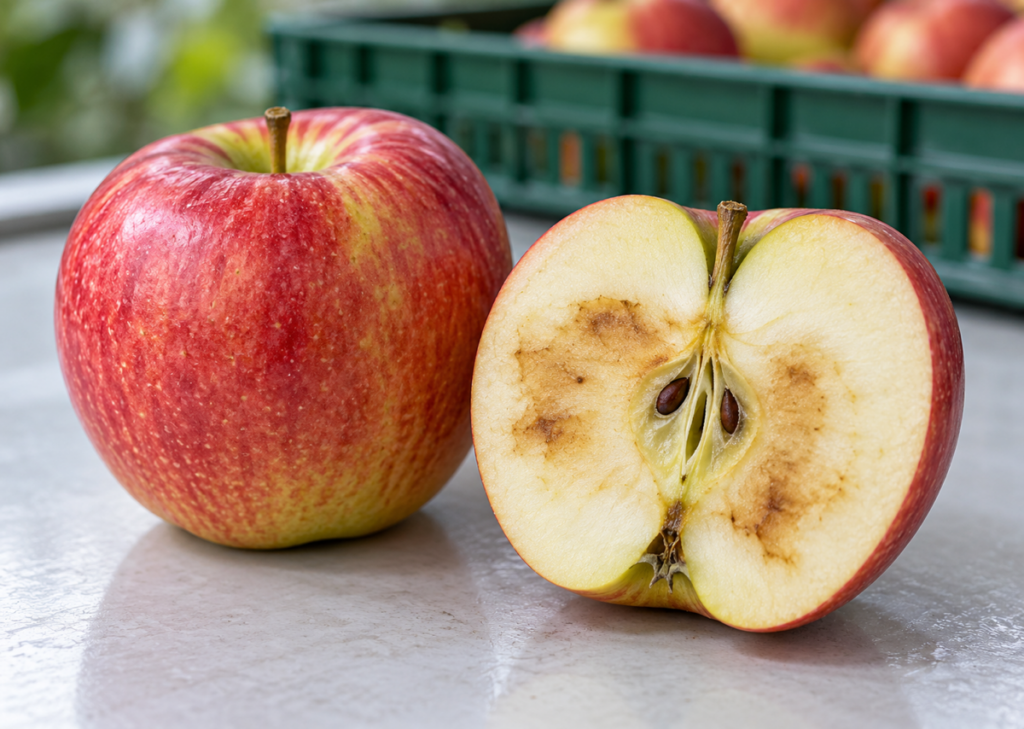
Automated Quality Control is Taking Us Beyond “Accept” and “Reject”
- Quality Control App

TL;DR
- Traditional FEFO (First-Expired-First-Out) relies on static printed expiration dates.
- In 2026, Dynamic Quality Routing uses real-time AI quality data to predict actual shelf life.
- Instead of rejecting loads, suppliers can now downcycle or re-route instantly.
- This transforms automated quality control from a cost center into a margin protection engine.
- AI fresh produce logistics systems are helping reduce waste by up to 30% while improving supply chain efficiency.
Why is the “accept or reject” model failing in 2026?
For decades, fresh produce operated on a binary outcome: accept or reject. A truck arrives. QC inspects. The load passes, or it doesn’t.
That model worked when freight was cheaper, margins were wider, and sustainability reporting wasn’t under scrutiny. In 2026, those conditions no longer exist.
Transport costs remain volatile, with labor becoming tighter and more expensive. At the same time, inflation has increased the cost basis of every shipment. So retailers are enforcing stricter compliance standards, while simultaneously demanding lower prices.
Rejecting a load after it has traveled thousands of miles used to be nothing more than a quality safeguard with an inconvenient outcome for the supplier. But in 2026, it is a margin destruction event.
When rejection happens:
- The supplier absorbs freight and potential disposal costs.
- The retailer absorbs operational disruption and shelf gaps.
- Rejection rates increase tension across the supply chain.
- Perfectly edible produce may be discarded due to spec misalignment.
In a perishable supply chain optimization environment, the old “reject and replace” mindset is simply too expensive. The industry needed a third path between full acceptance and total loss.
That third path is dynamic quality routing.
What is the difference between FEFO and dynamic quality routing?
FIFO (First-In, First-Out) is the most basic inventory management logic. Produce that enters the warehouse first is shipped first. This system works well for non-perishable goods where quality degradation is minimal or predictable.
FEFO (First-Expired-First-Out) was designed to minimize spoilage by shipping produce closest to its printed expiration date. For packaged goods, that logic holds. But for fresh produce, it breaks down.
Printed dates are estimates. They do not reflect:
- Firmness variability
- Brix (sugar content) differences
- Early-stage decay
- Bruising severity
- Ripening curves influenced by temperature exposure
FEFO vs FIFO: towards a truly quality-based standard
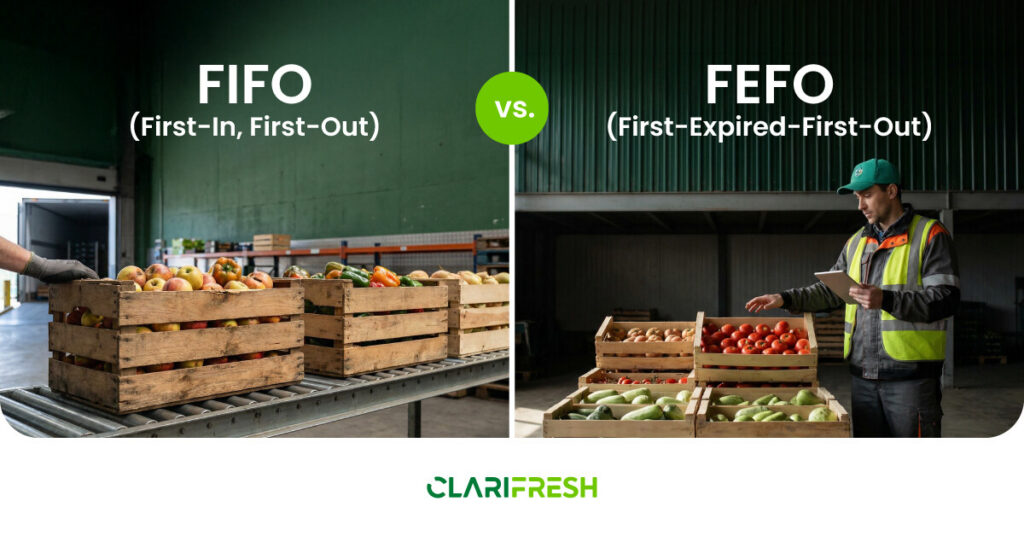
Because these are all dynamic parameters, two pallets harvested on the same day can perform very differently at retail. FIFO assumes time-in-storage determines quality. FEFO assumes printed date determines quality. Unlike both of these, dynamic quality routing measures actual condition.
That means that instead of asking, “Which pallet expires first?”, quality managers can now ask, “Where will this quality profile perform best?”
Dynamic routing relies on automated quality control systems to capture measurable attributes in real time: firmness scores, defect gradations, internal quality markers. Those data points replace static assumptions with live intelligence. FEFO vs FIFO may have been a live question in the past, but today’s supply chains are moving beyond both, toward condition-based decision-making.
How does smart routing work in practice?
Consider a truck of avocados inspected at origin. An AI-powered scan shows:
- 80% firm fruit
- Acceptable oil content
- Slightly accelerated softening trajectory
For a premium retailer requiring extended shelf presence, this load is borderline. Under traditional logistics automation models, it might pass FEFO checks but still fail upon arrival due to condition mismatch.
In the 2026 model:
- The quality scan digitizes the condition instantly.
- Shelf life prediction models estimate realistic remaining performance.
- That data flows into the Transport Management System (TMS).
- The system identifies a regional guacamole processor whose specs match the current firmness profile.
- The load is rerouted before retail rejection occurs.
Instead of a 100% write-off, the supplier sells at a controlled discount. The processor receives ideal input material. This way, the supplier avoids waste and protects its margins.
Why is AI necessary for dynamic quality routing?
Dynamic routing depends on speed and scale. Large operations handle thousands of pallets daily. Manual inspection cannot support real-time logistics automation at that volume. Human-led grading is subjective and difficult to digitize. It’s also too slow for routing adjustments in transit.
In contrast, AI-powered automated quality control systems use computer vision and predictive analytics to convert visual and physical inspection data into structured digital outputs.
Those outputs include:
- Firmness measurements
- Brix levels
- Defect classifications
- Estimated shelf life curves
Once digitized, this data becomes actionable. It integrates into the entire business ecosystem: ERP systems, inventory management platforms and transport routing software
This is where agentic AI begins to reshape the perishable supply chain. The system reports on quality accurately, then triggers routing decisions based on pre-set financial and compliance logic.
What is the financial impact of downcycling instead of rejecting?
Rejecting a load is financially absolute. When this happens, product value drops to zero. Additional transport or disposal costs may follow as a result. And contract penalties can compound this impact. All of this places strain on relationships..
Downcycling changes this equation. Selling to a processor at a 15-20% discount preserves the majority of shipment value. And even secondary retail channels may accept produce outside premium specs.
That’s the difference between a 100% loss and an 80% recovery. Across an operation moving thousands of loads annually, even modest reductions in rejection rates materially impact annual margin optimization. With dynamic routing, organizations can turn quality variability from a liability into a strategic lever.
How does dynamic quality routing integrate with existing systems?
This shift does not require dismantling existing infrastructure. Modern AI-powered quality control platforms integrate via API into:
- Transport Management Systems (TMS)
- ERP platforms
- Warehouse Management Systems
- Inventory forecasting tools
When quality data falls outside a retailer’s tolerance band, the system can trigger automatic alerts and generate alternative routing tickets, or even adjust inventory allocation. Procurement and sales teams receive notifications so they are never out of the loop.
The key difference that makes all of this possible is reaction timing. While traditional models discover mismatches at arrival, dynamic quality routing detects and responds at origin or during transit.
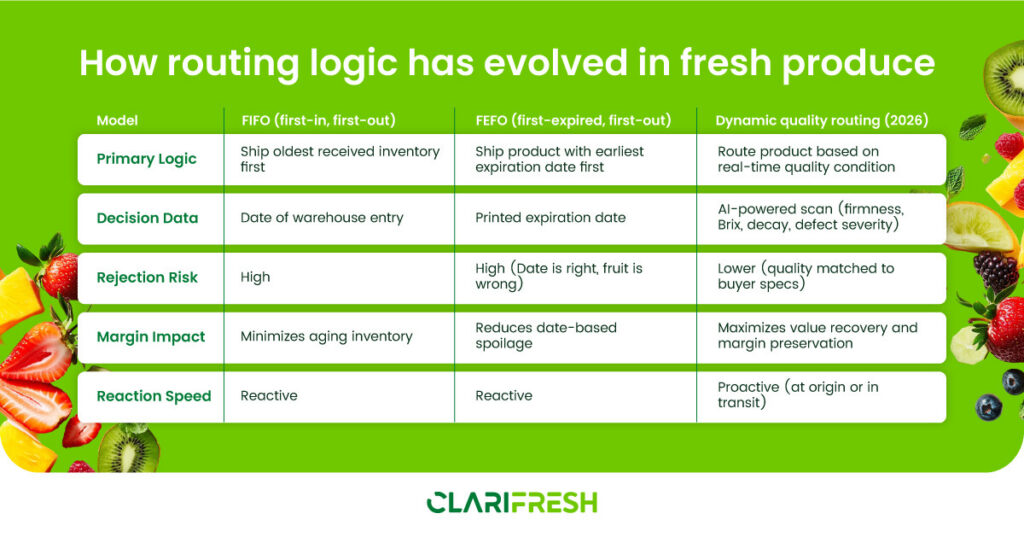
How routing logic has evolved in fresh produce
Inventory management in fresh produce has progressed in stages. Each step improved control, but each still relied on time as a proxy for quality.
Dynamic Quality Routing represents a structural shift: from time-based assumptions to condition-based intelligence.
Here’s how the models compare:
Who should own dynamic quality routing internally?
This is not simply a quality initiative. It’s a logistics strategy enabled by quality intelligence. Logistics Directors and Supply Chain VPs are best positioned to own this shift, because routing decisions sit within logistics control, and margin optimization is a supply chain responsibility.
The flow goes like this:
- Quality teams generate the data.
- Logistics teams operationalize it.
- Leadership aligns incentives around value recovery rather than rejection minimization.
The organizations that succeed treat automated quality control not as compliance infrastructure, but as financial infrastructure.
What are the sustainability and ESG implications?
Sustainability performance in fresh produce is increasingly tied to measurable reductions in food waste and shrink. Dynamic quality routing actively prevents edible produce from entering landfill streams. It also reduces unnecessary return freight and improves cold chain efficiency by avoiding redundant handling cycles.
Waste reduction and margin optimization begin to align. As a result, instead of overproducing to compensate for anticipated rejection rates, supply chains can optimize inventory management based on real performance data.
In 2026, sustainability is embedded in routing logic.
Is dynamic quality routing relevant for short-shelf-life categories?
Short-shelf-life items like berries, leafy greens and stone fruit face the highest rejection volatility. Small differences in firmness or decay progression dramatically affect retail performance.
In these categories, shelf life prediction powered by AI becomes especially critical. Real-time quality-based routing can determine whether a shipment is best suited for:
- Premium retail
- Discount retail
- Processing
- Regional distribution
- Immediate promotional channels
The shorter the shelf life, the greater the financial impact of routing precision.
FAQ
What is dynamic quality routing?
An AI fresh produce logistics strategy that uses real-time AI quality data to match fresh produce to the most appropriate destination based on actual condition rather than printed expiration dates.
Why is FEFO failing for fresh produce?
Because printed dates do not reflect real-time variability in firmness, sugar levels, and decay progression. FEFO assumes uniformity that does not exist in fresh categories.
How much can reducing rejections save?
Even shifting a portion of rejected loads into discounted secondary channels can preserve significant annual margin and reduce waste by up to 30%, depending on volume.
Does this work with my existing transport management system?
Yes. Quality data can integrate via API into TMS, ERP, and logistics automation systems to trigger routing decisions automatically.
Is this only for large global suppliers?
No. Any operation managing variability across multiple buyer specifications can benefit from quality-based routing logic.