How Produce Quality Disputes Happen, And How Inspection Data Resolves Them
- Quality Control App

Key takeaways:
- Produce quality disputes are common in global fruit and vegetable trade
- Most conflicts arise from subjective inspections and inconsistent standards
- Exporters and buyers often evaluate quality using different criteria and timing
- Structured inspection data creates shared visibility and objective evidence
- Digital inspections reduce disputes, claims, and costly shipment rejections
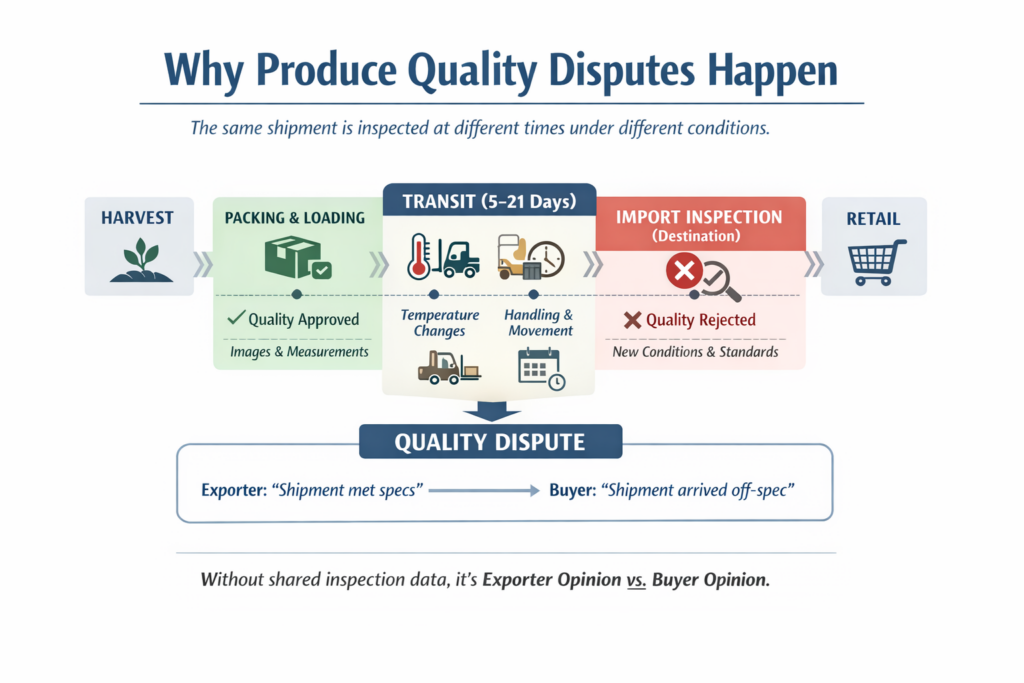
Fresh produce supply chains operate across continents, climates, and timelines. A shipment inspected at origin may arrive days or weeks later under very different conditions. And when quality expectations differ between exporters, importers, and retailers, disputes often follow.
Unlike many other industries, quality in fresh produce has historically relied on visual assessments and human judgment. When two people look at the same pallet of fruit and reach different conclusions, there is no shared record to adjudicate the disagreement. The result is a costly, trust-eroding conflict that neither party can easily win.
Why Are Produce Quality Disputes So Common in Global Supply Chains?
Fresh produce is not like other traded goods. From the moment of harvest, fresh fruits and vegetables are in constant decline. This biological reality creates conditions where disputes are almost inevitable without the right infrastructure.
Several structural factors contribute to the frequency of fresh produce quality control conflicts:
- Perishability: Quality deteriorates during transit, meaning the produce that leaves origin is not the same product that arrives at destination. The question of when and why deterioration occurred is rarely straightforward.
- Inspection timing: Exporters inspect at origin, importers inspect on arrival. The gap between these two assessments can be days or weeks, across different temperature conditions, humidity levels, and handling environments.
- Lack of standardized quality scoring: Unlike commodity markets with universal grading systems, fresh produce quality is often assessed against buyer-specific specifications. They all have their own definitions of acceptable colour, size, firmness, and defect tolerance.
- Volume and speed: Global supply chains move at pace. By the time a dispute is raised, the product may already be in distribution, making evidence collection difficult.
According to at least one survey, approximately 12% of fresh produce shipments encounter rejection or delay. Every produce shipment rejection adds financial exposure across an industry trading hundreds of billions of dollars annually.
//VISUAL IDEA:
What Are the Most Common Causes of Quality Disputes?
Disputes typically crystallise around a small set of recurring quality issues. These are not random failures, but predictable fresh produce quality control fault lines:
- Bruising and handling damage accumulated during packing, loading, or transit.
- Ripeness or maturity disagreements, where exporter and importer apply different inspection standards to what ‘ready’ means.
- Cosmetic defects such as scarring, discolouration, or surface marks that fall in the grey zone between acceptable and rejectable.
- Size and colour variability that fails to meet buyer-specific tolerances, even when within broad industry standards.
- Shelf-life expectations that diverge based on when and how quality was evaluated.
Each of these categories involves a degree of interpretation. When that interpretation happens independently at origin and destination, with no shared framework connecting them, conflict is the likely outcome.
Why Subjective Inspections Lead to Disagreement
The picture we’ve painted is painfully common, and it has nothing to do with incompetence on either side. The reason exporter and importer disputes are hard to avoid is that the fresh produce inspection process itself is built on subjectivity. Two trained inspectors, looking at identical produce, can reach meaningfully different conclusions based on:
- Training differences: Inspectors learn quality assessment in different environments, from different trainers, against different reference materials.
- Inspection methods: Manual tools (color charts, sizing rings, visual sampling) introduce inherent variability. Sampling a small portion of a shipment and extrapolating across the whole consignment compounds the uncertainty.
- Environmental conditions: Lighting, temperature, and time pressure all affect human perception of quality attributes.
- Buyer expectations: Exporters serving dozens of buyers simultaneously cannot maintain perfect mental models of each customer’s specific tolerances.
From the exporter’s perspective, the problem is structural. Each buyer typically provides their own quality specification document. These documents can be lengthy, in different languages, with different formats, and entirely different ways of describing colour or defects. There is no standardization between them. The exporter, unable to run twenty separate produce inspection processes, creates their own internal standard. That standard may differ meaningfully from what the buyer expects.
Once that produce arrives, the exporter’s inspection says “acceptable” and the buyer’s inspection says “substandard.” Both may be right, by their own criteria. Neither has objective evidence to resolve the gap.
What Happens When Supply Chain Disputes Escalate?
When you can’t resolve a dispute, it has consequences that move through the supply chain in predictable ways:
- Shipment rejection: The buyer refuses to accept the consignment, leaving the exporter responsible for a perishable product with rapidly declining value.
- Price renegotiation: Rather than outright rejection, the buyer demands a discount, a cost the exporter absorbs without any formal process or shared evidence base.
- Product destruction: Rejected produce that cannot find an alternative buyer within its remaining shelf life is destroyed, representing a total loss.
- Strained supplier relationships: Repeated supply chain disputes erode trust, making long-term commercial relationships harder to sustain.
- Legal claims: In more serious cases, disputes escalate to formal claims. The absence of objective quality verification disadvantages the party who cannot produce quality inspection data.
The UK’s Global Food Security Programme has reported that supermarkets reject as much as 40% of fresh produce due to quality non-compliance. Even at more conservative industry estimates, the financial exposure at a per-shipment level is substantial.
Quality Inspection Data Creates the Objective Evidence Organizations Desperately Need
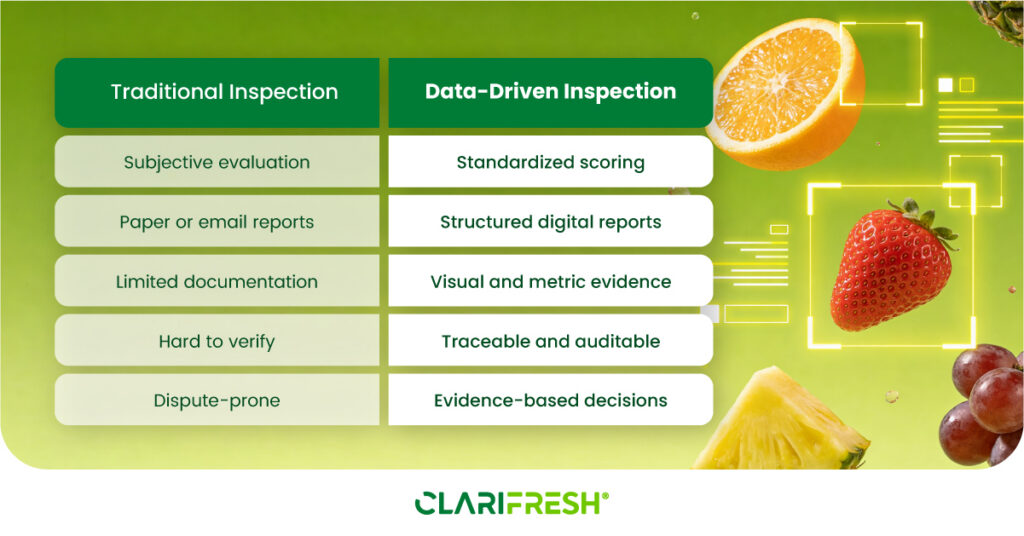
Structured inspection data changes the nature of the problem. Instead of one party’s word against another’s, there is a documented record. It’s timestamped, georeferenced, and tied to specific quality parameters that both parties can examine.
- Documenting quality conditions at origin: A timestamped inspection record with images and metric data establishes a baseline. If quality has deteriorated in transit, the record helps attribute responsibility accurately.
- Standardizing quality scoring systems: When inspection software maps different buyer specifications onto a common evaluation, it eliminates the ambiguity that generates disputes.
- Capturing images and measurements: Objective visual and numeric evidence replaces subjective description. A defect percentage derived from image analysis carries more weight than a disputed visual impression.
- Creating auditable quality records: A complete digital history of each shipment means that disputes can be resolved with reference to facts, not recollection.
Critically, even where only one party adopts a structured inspection process, the asymmetry shifts in their favour. An exporter who can present a detailed, data-backed inspection report is in a fundamentally stronger position than one who cannot.
Traditional vs. Data-Driven Inspection: A Comparison
How Digital Inspections Reduce Disputes Across the Supply Chain
When exporters and buyers share a common inspection framework from the outset, quality expectations are aligned before shipment rather than contested after arrival. Buyers can access pre-shipment fruit quality inspection data and flag concerns in advance. Exporters can match produce to the right buyer based on actual quality scores rather than estimates.
The benefits go beyond speed or even accuracy. Inspection consistency is a major operational gain in itself. Customers and supply chain partners value consistency and predictability almost above all else.
Across the supply chain, the effects of structured inspection data are consistent: fewer disputes at point of delivery, faster resolution when disputes do arise, and a reduction in the financial exposure caused by rejection and renegotiation.
Who Benefits Most From Inspection Data?
The benefits of structured inspection data are not confined to a single supply chain role. Each stakeholder gains something distinct:
- Exporters: Objective evidence protects against unjustified rejections and price renegotiations. Fruit quality inspection records become a commercial asset.
- Importers: Pre-shipment data reduces the risk of receiving off-spec product. Visibility into quality before arrival enables proactive planning.
- Retailers: Consistent quality data supports forecasting, reduces in-store waste, and builds confidence in supplier reliability.
- Quality managers: Standardized digital workflows replace manual, paper-based processes, improving inspector productivity and audit readiness.
- Logistics teams: Quality documentation tied to shipment records helps isolate where deterioration occurred, enabling better cold chain management over time.
Frequently Asked Questions
Why do produce quality disputes happen so often?
Quality disputes are common because fresh produce is perishable, inspected at multiple points in the supply chain, and evaluated against inconsistent inspection standards. When exporter and buyer inspections happen at different times, in different conditions, and against different specifications, disagreements are a predictable structural outcome.
How can exporters reduce quality claims from buyers?
The most effective approach is to conduct standardized, documented inspections at origin and share the results with buyers before delivery. When buyers have access to pre-shipment inspection data, the scope for post-arrival disputes narrows. Structured digital inspections reduce both the frequency of claims and the time needed to resolve them.
What documentation helps resolve produce disputes?
Timestamped produce inspection reports with photographs, quantitative produce quality metrics (colour readings, size measurements, defect percentages), and clear traceability to the specific shipment or lot. Documentation that is structured, standardized, and generated at the point of inspection carries substantially more weight than retrospective accounts or informal communications.
How do digital inspections improve transparency in produce trade?
Digital inspection platforms create a shared record that both exporter and buyer can access. Rather than relying on separate, incompatible inspection processes, both parties work from the same data. This shared visibility reduces information asymmetry, which makes quality disputes difficult to resolve.
Can inspection data be used as evidence in quality claims in produce supply chains?
Yes. Structured, timestamped inspection records provide documentary evidence in formal disputes. In practice, the availability of objective inspection data often prevents claims from escalating to formal proceedings, because one party’s evidence base is strong enough to resolve the disagreement at the commercial level.
Conclusion
Produce quality disputes are not simply a result of bad actors or careless handling. They are a predictable consequence of a supply chain that has historically lacked the infrastructure to create shared, objective evidence about quality at every stage.
When inspection data is structured, standardized, and visible to all relevant parties, the conditions that generate disputes are systematically reduced. Exporters gain protection. Buyers gain confidence. And quality managers gain the tools to make faster, more defensible decisions.
As inspection technology matures, the fresh produce industry is acquiring the infrastructure it has long needed to resolve its most persistent operational challenge.