Dairy Quality Assurance Has a Data Problem, and It’s Getting Expensive
- Quality Control App
Reducing Waste, Recalls, and Compliance Risk
Key takeaways:
- Sensitivity: Dairy is one of the most sensitive food categories, leading all others in global recall volume.
- Recall risk: Small quality failures can cascade into major recalls, supply chain disruption, and brand damage.
- The data gap: Dairy operations generate quality data at dozens of checkpoints, but fragmented systems make it difficult to act before problems escalate.
- Structured data pays off: Centralised quality data improves traceability, compliance, and risk detection across the supply chain.
- The shift is underway: Modern dairy operations are increasingly adopting data-driven quality management — and the gap between early movers and laggards is widening.
Dairy products move through one of the most tightly controlled supply chains in the food industry. At every step, the margin for error is narrow. Milk is biologically active, temperature-sensitive, and highly perishable, which means quality monitoring cannot be an afterthought.
These factors underlie the sophistication of modern dairy testing: automated bacteria counts, somatic cell monitoring, continuous pasteurization logging. But despite these methods, many operations still struggle with a fundamental problem: the data generated at each checkpoint rarely connects to anything else.
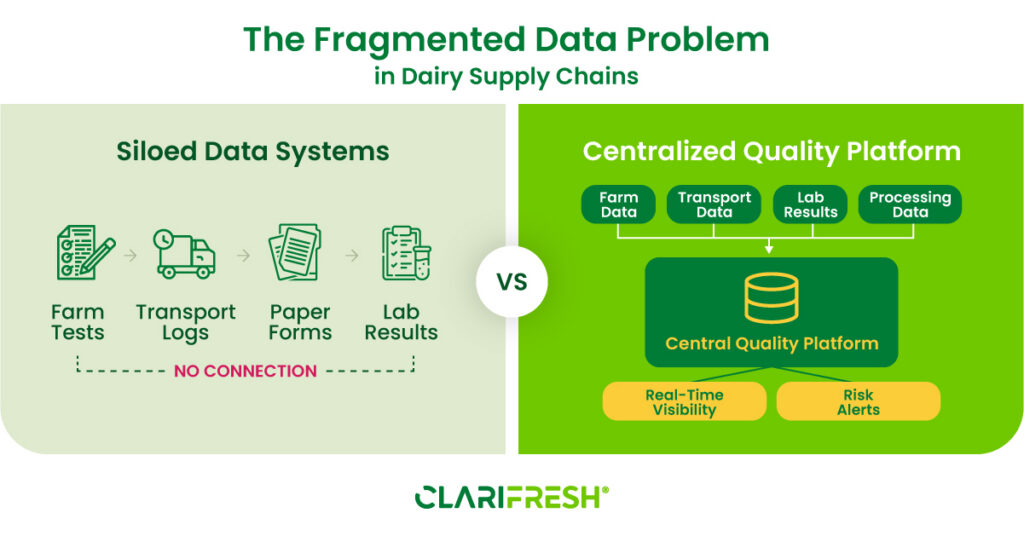
Lab results sit in one system. Temperature logs live in another. Inspection records are captured on paper or in spreadsheets. By the time a quality issue surfaces, the product has already moved downstream.
This article examines why dairy supply chain quality demands rigorous quality monitoring, what the real cost of getting it wrong looks like, and how structured, centralised quality data is changing the risk equation for processors, retailers, and supply chain managers.
Why Dairy Supply Chain Quality Control Need Extra Strict Monitoring
Dairy is not like other food categories. The biological sensitivity of raw milk, combined with the speed at which it moves through distribution, creates compounding risk at every stage.
Several factors make dairy uniquely demanding from a quality standpoint:
- Biological sensitivity: Raw milk is a growth medium for a wide range of pathogens: Listeria monocytogenes, Salmonella, E. coli, Campylobacter and others. These can reach dangerous concentrations rapidly if temperature or hygiene controls slip. The FDA identifies over a dozen known bacterial hazards specific to dairy products.
- Rapid spoilage potential: Unlike shelf-stable products, dairy has a short window between production and consumption. Spoilage is often invisible and odourless until late in the process, meaning sensory checks alone are insufficient.
- Strict regulatory oversight: Dairy is subject to mandatory pasteurization verification, somatic cell count limits, antibiotic residue testing, and pathogen monitoring at both farm and processing levels. Regulatory requirements vary by market, adding complexity for operations that export or operate across multiple jurisdictions.
- Consumer safety expectations: A single contamination event in dairy carries the potential for serious illness. The public health stakes are higher than in most food categories.
These factors don’t operate in isolation. A temperature deviation during transport, for instance, doesn’t just affect spoilage. It can accelerate pathogen growth that was already present at low, undetected levels. So quality risks in dairy are interconnected and fast-moving.
What Are the Biggest Risks in Dairy Quality Management?
Quality failures in dairy tend to cluster around a predictable set of risk factors, most of which involve either contamination or loss of control over critical process parameters.
- Bacterial contamination: The most serious risk category. Listeria, Salmonella, and E. coli are the primary pathogen concerns. Listeria is particularly dangerous because it can survive and multiply at refrigeration temperatures, meaning cold chain compliance alone is insufficient protection.
- Temperature deviations: Milk must be held below 45°F (7°C) throughout transport and storage. Even brief excursions above this threshold can dramatically accelerate bacterial growth and reduce shelf life. Temperature failures are often the proximate cause behind a dairy contamination detection.
- Improper storage and handling: Post-pasteurisation contamination is a significant and underappreciated risk. Improperly cleaned equipment, cross-contamination from environmental sources, and allergen co-mingling are all common causes of recalls.
- Transport delays: Extended transit times increase the risk of cold chain failure and product degradation. Without real-time monitoring, these events may not be detected until the product reaches the distribution centre or retail store.
- Packaging failures: Seal integrity issues, mislabelling, and undeclared allergens are consistently among the top causes of dairy recalls.
What these risks share is that most of them are detectable before product leaves a facility, provided the right monitoring systems and data infrastructure are in place.
The Financial and Operational Cost of Dairy Recalls
Dairy recalls are not rare events. According to FOODAKAI’s Global Food Recall Index, dairy led all food categories in global recall volume in Q1 2025. That’s a position it has occupied repeatedly in recent years.
The costs of a recall extend well beyond the immediate product loss:
- Product destruction and recovery: Recalled products must be identified, retrieved from distribution, and destroyed. For a large-scale recall spanning multiple SKUs and retail channels, logistics costs alone can run to millions of dollars.
- Regulatory investigations: A recall triggers scrutiny from the FDA or equivalent regulatory body. Investigations are resource-intensive, and can result in mandatory facility shutdowns.
- Brand damage: Consumer trust is difficult to rebuild after a recall, particularly if the event involved a serious pathogen. The reputational cost extends beyond the immediate event, affecting retail listings, private label contracts, and export relationships.
- Supply chain disruption: A single dairy supplier recall can cascade across the supply chain. As the 2024 Rizo Lopez Foods Listeria outbreak demonstrated, a contamination finding in one cheese product triggered public health alerts across downstream meat and poultry products that had used the dairy ingredient.
The most damaging recalls almost always share one characteristic: the quality failure was detectable earlier, but the systems in place weren’t able to surface it in time.
Why Traditional Quality Monitoring Systems Create Blind Spots
Dairy quality control already involves a high volume of testing, using infrastructure that is largely in place. The problem is what happens to the data those tests produce.
In most conventional dairy operations, quality data is generated across multiple systems that were never designed to communicate with each other:
- Fragmented quality records: Lab results, temperature logs, inspection reports, and supplier certifications typically live in separate systems. Without a unified view, quality teams lack the context to identify patterns or act proactively.
- Inconsistent testing protocols: Without standardized digital workflows, testing procedures can vary between shifts, facilities, and personnel. This inconsistency undermines the reliability of the data itself, making trend analysis unreliable.
- Delayed reporting: Many quality checks depend on lab turnaround times that can stretch to 24–48 hours. When results feed into disconnected systems rather than a central dashboard, the delay between a quality event and a response decision is compounded further.
- Limited traceability: When a quality issue is detected, organizations need to trace it back to its source, such as a specific supplier, batch, tanker route, or processing run. But that depends entirely on the completeness and accessibility of historical records.
As a result, quality management posture is reactive: problems show up after the fact, often when the product has already moved into distribution. The data existed at an earlier stage, but it wasn’t connected.
//VISUAL IDEA: This is the right place to add a visual, because this fragmentation issue seems to me the strongest part of our value prop for dairy.
How Structured Quality Data Improves Dairy Risk Management
The shift toward data-driven quality management in dairy is about making the data that tests generate actually useful. Centralized, structured quality data does this in several concrete ways:
- Early anomaly and contamination detection: When quality data from multiple checkpoints feeds into a single system, deviations become visible in context. A bacteria count that is technically within acceptable limits but trending upward over several days is a very different signal than a one-off reading. In either case, dairy contamination prevention is made more reliable at scale.
- Consistent monitoring across facilities: A standardized, data-powered dairy inspection process that the same parameters are captured consistently. This makes cross-facility comparisons meaningful and reduces the variability that creates blind spots.
- Faster dairy compliance reporting: Regulatory audits require documented evidence of quality checks, corrective actions, and traceability records. When this data is structured and centralized, audit preparation is a reporting task rather than a manual reconstruction exercise.
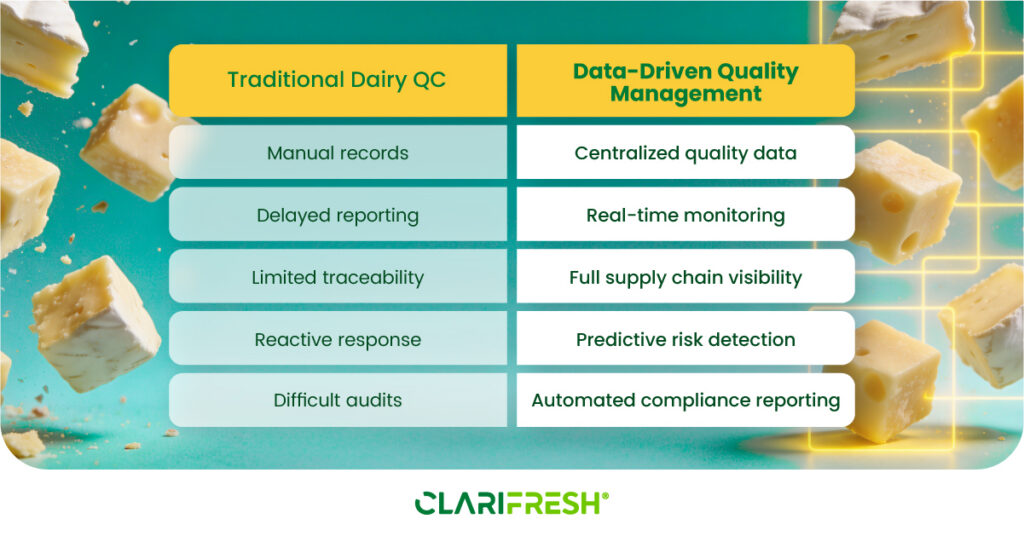
Traditional Dairy QC vs. Data-Driven Quality Management
How Data-Driven Quality Systems Reduce Waste and Recalls
The business case for structured quality data in dairy is most visible in its impact on recall frequency and operational efficiency.
Continuous, connected monitoring means that out-of-spec readings trigger alerts in real time rather than surfacing in a weekly lab report. Containment decisions can be made at batch level rather than at the scale of a full production run.
Structured quality data also creates a detailed record of the conditions a product experienced throughout its journey. This supports more accurate shelf-life decisions, reduces unnecessary write-offs from overly conservative dating, and improves matching of stock to customer specifications.
All of this leads to faster and more evidence-based decision-making about acceptance and pricing.
Who Benefits Most from Dairy Quality Data?
The value of structured quality data is not confined to the lab or the quality assurance team. Across the dairy supply chain, stakeholders gain from better data infrastructure:
- Dairy processors: Reduced recall exposure, faster response to quality events, and streamlined regulatory compliance. Data-driven quality management also supports continuous improvement, because processors can track performance trends over time and identify systemic issues before they become costly.
- Quality assurance teams: Structured data replaces manual record-keeping and spreadsheet management with audit-ready documentation. QA managers gain a real-time view across facilities rather than a retrospective picture assembled from multiple sources.
- Regulators: Regulatory bodies increasingly expect dairy operations to demonstrate documented, traceable quality management systems. Centralized quality data simplifies dairy compliance and reduces the friction of regulatory inspections and audits.
- Retailers and buyers: Retailers operating private label dairy programmes or tight quality specifications need confidence that supplier quality is consistent and verifiable. Structured data supports the kind of transparency that underpins commercial trust.
- Supply chain managers: Visibility into quality performance across the supply chain enables better sourcing decisions, supplier management, and logistics planning.
Frequently Asked Questions
How is milk quality tested before processing?
Raw milk undergoes a series of tests before entering a processing facility:
- Total Bacteria Count (TBC) measures overall microbial load using automated flow cytometry
- Somatic Cell Count (SCC) indicates udder health and herd management quality
- Mandatory antibiotic residue screening is an additional regulatory requirement in most markets.
Temperature is also verified, as raw milk must be held below 45°F (7°C) to limit bacterial growth. Sensory checks for smell and appearance may be performed by trained receivers.
What causes most dairy recalls?
Dairy recalls are most commonly triggered by:
- Bacterial contamination (Listeria monocytogenes, Salmonella, and E. coli are the most frequent pathogens)
- Undeclared allergens due to mislabelling or cross-contact during processing
- Elevated coliform counts indicating sanitation failures.
Packaging integrity failures and premature spoilage due to process deviations are also significant causes.
How do dairy companies monitor contamination risk?
Contamination risk is managed through a combination of process controls and verification testing. Critical control points are monitored continuously in modern facilities. Environmental monitoring (surface swabs for coliforms and aerobic plate counts) validates cleaning effectiveness. Finished product is tested for pathogens before release.
The gap in many operations is not the testing itself but the integration of results: when data from these checks lives in disconnected systems, the ability to detect patterns and respond proactively is limited.
What role does data play in dairy quality management?
Data is the connective tissue between individual quality checks and meaningful quality management. Individual test results tell you whether a specific batch passed or failed a specific parameter. Structured, centralized quality data tells you whether performance is trending in a particular direction, which suppliers or processes are driving variability, and where in the supply chain risk is concentrating. This shift from point-in-time measurement to continuous monitoring is what separates reactive quality control from genuine risk management.
How can dairy companies improve dairy compliance and traceability?
The most effective approach is to centralise quality data into a unified platform that links test results to the batch, supplier, process, and personnel they relate to. This creates an audit trail that is both comprehensive and instantly queryable. Standardising inspection systems across facilities ensures data consistency.
That consistency makes compliance reporting reliable and cross-site comparison actually meaningful.
Conclusion
Dairy has always required rigorous quality management. What has changed is the expectation of what ‘rigorous’ looks like. Regulators want documented, traceable, continuously monitored systems. Retailers want consistent, verifiable quality data.
And the scale and complexity of modern dairy supply chains means that disconnected, paper-based inspection records are no longer fit for purpose.
If your quality data still lives in spreadsheets, paper logs, or disconnected systems, you’re managing risk retrospectively. Clarifresh brings it all into one place, so you can act on quality signals before they become recall events. Book a demo to learn more about integrating Clarifresh’s quality control capabilities into your dairy operations.